NEWS
The Climate and Sustainability Committee advanced two utility resolutions 3-0 before Entergy, MISO, a renewable developer and advocacy groups walked members through the transmission limits behind the May 2025 load shed and the data center surge reshaping regional planning.
By Kim M. Braud | November 16, 2026
The New Orleans City Council's Climate and Sustainability Committee voted to open a regulatory docket on plug-in "balcony" solar and set a short comment window on Entergy New Orleans' community solar billing plan. It then devoted the remaining two hours of the meeting to what committee chair Councilmember Aimee McCarron called the council's first transmission education day.
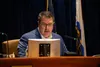
Council President JP Morrell, Vice President Matthew Willard and McCarron answered roll call. Councilmember Eugene Green joined during the presentations.
Two votes, both 3-0
Plug-in solar docket. The first resolution opens a new docket and procedural schedule to consider how the council should regulate small portable solar devices. These panels plug into a standard wall outlet, need no contractor, and can sit on a balcony, porch or lawn. McCarron said they give renters and homeowners with unsuitable roofs a path to solar, and that at least 30 states have or are considering rules for the devices, with 10 already approving them. The resolution passed 3-0.
Community solar consolidated billing. The second resolution sets a comment period on Entergy New Orleans' compliance implementation plan for community solar consolidated billing, which the utility filed Oct. 19. The plan asks the council to approve the implementation approach, cost recovery provisions and changes to program rules. Written comments are due Nov. 24 and reply comments by Nov. 30. McCarron urged parties to file early because a community solar project is due to come online at the end of the year. The resolution passed 3-0.
Both items go to the consent agenda for the full council's Thursday meeting.
The load pocket problem
Transmission lines carry high-voltage power from generating plants to local substations. Harry Barton, director of regulatory affairs for Entergy New Orleans, told members the entire metro area sits inside a "load pocket," a region with limited ability to import power from outside. New Orleans falls within the Downstream of Gypsy pocket, which itself sits within the larger Amite South pocket. That means a set amount of generation must stay online inside the region at all times.
Barton said Entergy plans 10 to 20 years ahead depending on the process, and that planning expressly considers the council's Renewable and Clean Portfolio Standard. He listed renewables that came out of the utility's 2016 request for proposals: the 20-megawatt New Orleans Solar Station, the 50-megawatt Iris Solar and the 20-megawatt St. James Solar, plus a 5-megawatt rooftop program. He said Entergy New Orleans intends to issue a new renewables RFP in 2027, driven mainly by RCPS compliance.
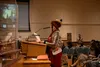
Madeline B., an engineer with the nonprofit GridLab, presented remotely after flight delays. She said a single 500-kilovolt line serves as the backbone into the area and traced the May 25, 2025 load shed to the outage of one of those lines, compounded by planned and unplanned generation outages and hot weather. MISO and Entergy both cited limited transfer capability as a factor, she said.
She told members that weather and equipment outages are facts of grid operation, but what gets built is the piece regulators control. She noted that Entergy has proposed new 500-kV and 230-kV lines for the region, but said transmission takes five to 10 years to build once approved, so those fixes arrive after the outages they were meant to prevent. Her recommendations: use the council's seat in the Organization of MISO States, weigh in on MISO's annual and long-range planning, require generation owners to study correlated outage risk across gas and renewable fleets, and push for extreme weather benefits to be valued under FERC Order 1920.
Green asked what Louisiana as a whole should do. She pointed to a more diverse generation mix, more renewables and storage, and stronger connections with Texas, the Southwest Power Pool and the Southeast. When she framed the issue as the city "versus" the state, Green corrected her. "We're not at war with the state," he said. "We all have the same interests."
MISO on data centers and who pays
Matt Loftus and Edin Habibovic both presented for MISO, the regional grid operator covering 15 states and about 45 million people. Loftus said the 2026 summer peak reached 125.5 gigawatts on June 30, just under the 2011 record of 127.1 GW, and that MISO's own September value study claims $21 in member value for every $1 spent. He also told Green that the council is an active MISO stakeholder and that he meets with council representatives nearly every month.
Habibovic said more than $14 billion in transmission investment is expected to go to MISO's board for approval in December, about $4.2 billion of it tied to load growth. He said MISO approved more than 26 gigawatts of data center load additions this year and expects more than 40 GW in service across its footprint by 2032. Data centers can connect in 18 to 36 months, he said, while large transmission lines take seven to 10 years. MISO is shifting toward probabilistic planning to model extreme events like May 2025 and has begun its first long-range study focused on MISO South.
Willard asked what happens to grid investments if data centers go offline or become obsolete. Loftus said MISO was filing its response to FERC's large load show cause order that day, proposing three-party agreements under which a data center that fails to meet its obligations owes payments so other customers are held harmless. MISO has separately filed operating requirements so a large load tripping offline does not degrade service elsewhere.
Morrell pressed further. Speaking, he said, with his "lawyer hat" on, he asked that liability rest with the parent company rather than a standalone data center subsidiary that could go bankrupt. Loftus said the filing assigns costs to the party that causes them and may require security against default, but said he would follow up through council staff on who signs the agreements.
Morrell also noted that Entergy Louisiana has approved a massive data center facility with power plants, while New Orleans has approved none, yet the city's power travels through Entergy Louisiana's system. He asked for a discussion at the next OMS board meeting about protecting New Orleans from interruptions caused by another member's decisions. Morrell credited MISO with giving earlier notice of potential load shed events since May 2025.
A developer that builds around Louisiana
David Minum, senior director at EDP Renewables, said the Houston-headquartered developer has roughly 13 GW installed across North America and projects surrounding Louisiana, but none built in the state. He said one current project in the Cleco system in northwest Louisiana cannot move forward until a regional fiber communications network is upgraded, at a cost of roughly $60 million. "That is not a viable number for us," he said.
He described three requirements for an independent project: permitting certainty, a buyer for the power, and transmission certainty. Louisiana meets the first two, he said. Green suggested the company ask the state directly for infrastructure support, citing state investment around major industrial projects.
Panel: who bears the outages
Sam Gomberg, associate director of transmission policy at the Union of Concerned Scientists, presented findings from the group's "Power After the Storm" report. He said every one of the 100 worst outage days on the MISO system from 2014 to 2024 was tied to large-scale extreme weather, all 10 of the worst events have happened since 2020, and the counties ranked most socially vulnerable by the CDC experienced the most hours without power. He said Louisiana could go from about 25 days a year above 100 degrees to roughly 130 if emissions are not reduced.
Yvonne Capel Vickery, clean grid manager at the Alliance for Affordable Energy, cited a National Bureau of Economic Research finding that customers in MISO South and the southern Southwest Power Pool paid more than $2.2 billion in 2022 because of grid bottlenecks between the two. She said 57% of Entergy New Orleans' capacity is fueled by natural gas, and more than 70% statewide.
McCarron asked what it would take to connect with SPP to the west or Southern Company to the east. The Alliance pointed to political will. Gomberg said the seams between regions reflect how the grid was built decades ago.
Barton said the May 2025 load shed would not have been avoided by interregional connections. Barton said the May 2025 load shed would not have been avoided by interregional connections. He said the line now under construction would have prevented it, and that a recent MISO-SPP study found proposed seam projects did not deliver enough benefit. Gomberg countered that the study weighed only one category of benefit, and that FERC Order 1920 now requires grid planners to value reliability and resilience. Loftus said annual MISO projects will add import capability into the load pockets, and that MISO's long-range South study specifically targets the Louisiana and Texas pockets.
Public comment
Andy urged proactive planning rather than reactions to events like a Mardi Gras Day blackout and the May 2025 load shed.
Denise Collins, a Gentilly resident, said her power had been off for a month, that she was unable to get bill assistance through Total Community Action this cycle after 25 years in the program, and that she faces an $882 bill. McCarron sent a staff member to connect her with an Entergy representative.
Madeline Smith of the Southeastern Wind Coalition tied transmission to economic development and said that, by her reading of 2024 compliance filings, about 5.5% of the RCPS obligation is being met with renewable energy.
Wendy Beck, speaking for the Deep South Center for Environmental Justice, said that to the group's knowledge council members do not actively take part in MISO's board meetings held in New Orleans. She said that when the Organization of MISO States adopted a position calling for large loads to pay the costs they create, Louisiana and Mississippi regulators supported it and the New Orleans City Council abstained. The center asked the council to explain that vote.
Carla Frias Romain, also of the Southeastern Wind Coalition, urged consistent council involvement in MISO's long-range planning. A speaker identified as Brian voiced support for wind and solar.
An online comment from Brent Bailey and Ted Thomas, former utility regulators in Mississippi and Arkansas, urged the council to take an active, in-person role at OMS and the Entergy Regional State Committee, where it holds a seat and a vote.
Closing
Green said the council is responding to suggestions like those offered, pointing to wooden pole replacements in his district, and called for more engagement at the state level. McCarron said a community solar project is due online by year's end and the council's community power plan begins implementation early next year. She noted the council's regulatory authority lets it act without going through the Louisiana Public Service Commission.
Kim M. Braud is the Founder & Editor of Evans Cutchmore Press, an independent newsroom covering Louisiana and the Gulf South, and the author of Financial Power for Life™, a financial literacy framework that helps people earn, protect, grow, leverage, and transfer wealth. Her reporting focuses on government, infrastructure, business, culture, and the public policies that shape communities, with a commitment to highlighting progress and the people doing meaningful work in a news landscape often dominated by conflict and crisis.
© 2026 Evans Cutchmore Press. All rights reserved.