INFRASTRUCTURE | NEWS ANALYSIS
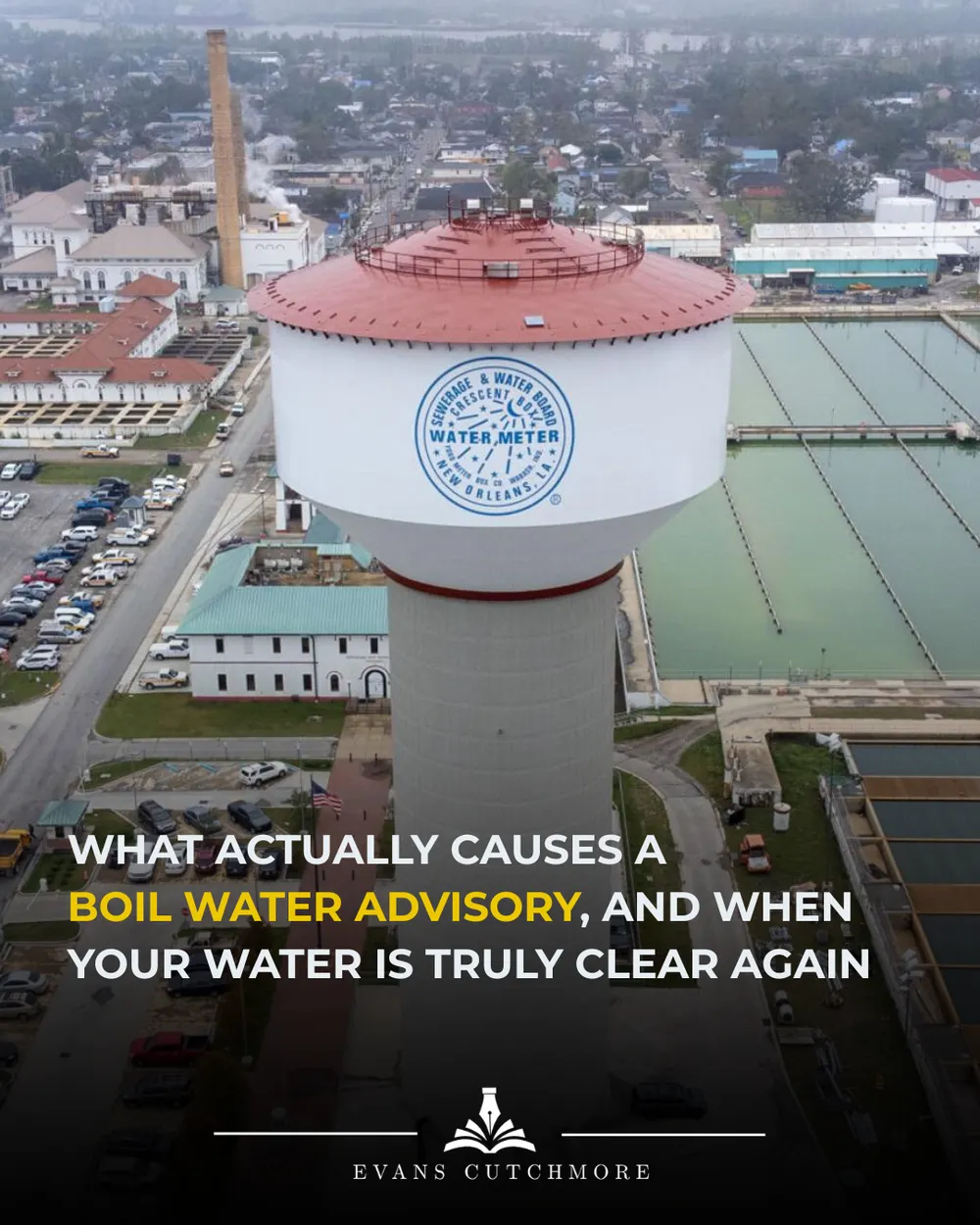
The West Bank of Orleans Parish came off a precautionary boil water advisory at noon on Sunday, July 26, after the Louisiana Department of Health cleared the tap water as safe. The Sewerage and Water Board of New Orleans had issued the order early Saturday morning, at 7:02 a.m., after a maintenance job on a water tower at the Algiers Water Plant caused system pressure to drop below the safety threshold. There was no water main break. The east bank was never affected.
Kim M. Braud | July 26, 2026
That is the news. But the news leaves most residents with the same questions every time this happens. Why does a pressure drop mean I have to boil my water? Who decides when it is over? And here is the one almost nobody answers: when the advisory lifts, is that not the same water sitting in my pipes that I was told not to drink an hour ago?
This is what a boil water advisory actually is, why pressure is the trigger, and when the water coming out of your faucet is genuinely clear.
The number that starts it all: 20 psi
Nearly every boil water advisory in New Orleans traces back to a single measurement. The Sewerage and Water Board is required to keep pressure in its distribution system at or above 20 pounds per square inch. When pressure anywhere in the system falls below that line, an advisory follows, whether or not any contamination is ever found.
The 20 psi rule is not arbitrary. Water pressure is what keeps a pipe network sealed against the world around it. Buried water mains do not run through clean, empty space. They run alongside sewer lines, through soil, past decades of leaking joints and hairline cracks. As long as the water inside is pushing outward at positive pressure, nothing outside can get in. Leaks push water out, not contaminants in.
When pressure drops toward zero, that protection reverses. Engineers call the danger back-siphonage: a sudden loss of pressure can create suction inside the main, and if the pressure goes negative, the direction of flow reverses. Groundwater, soil, or waste sitting against a cracked pipe or an unprotected cross-connection can be pulled into the drinking water system through the same openings that normally leak outward. The U.S. Environmental Protection Agency treats loss of adequate pressure as a breach of a system's integrity, a moment when the barrier that keeps drinking water clean is no longer guaranteed.
That is why the advisory is issued the instant pressure falls below 20 psi, even before a single sample is tested. The utility is not saying the water is contaminated. It is saying the seal was broken, and it cannot yet prove nothing got in.
Why they call it "precautionary"
Saturday's order carried the word precautionary, and that word does real work. It signals a pressure event with no confirmed contamination and no main break, as opposed to an advisory issued because bacteria were actually detected. The great majority of New Orleans advisories are the precautionary kind, prompted by pump interruptions, power surges at a treatment plant, or planned maintenance like the tower work in Algiers.
Precautionary does not mean pointless. Until the water is tested, the utility cannot distinguish a harmless pressure dip from one that let something in. Boiling is the fallback that makes the question moot: a rolling boil for one minute kills the bacteria, viruses, and parasites that a pressure breach could theoretically introduce. Residents are told to boil, or use bottled water, for drinking, cooking, making ice, preparing baby formula, and brushing teeth. Bathing and showering remain fine for adults, as long as you do not swallow the water.
Who decides it is over
An advisory does not lift on a schedule. It lifts on lab results.
Once pressure is restored, the Sewerage and Water Board collects water samples across the affected area and sends them to a laboratory, in consultation with the Louisiana Department of Health. The tests look for bacterial contamination, and the results typically take 18 to 24 hours to come back. Only the health department can clear the water. That is why even a short pressure event produces an advisory that lasts a full day or more: the clock is set by the biology of a lab culture, not by how quickly pressure returned.
For Saturday's event, pressure was restored quickly and the samples came back clean, and LDH lifted the order at noon Sunday, roughly 29 hours after it began.
The part nobody explains: the water already in your pipes
Here is the question that trips up almost everyone. If they told me not to drink the water on Saturday, and the water in my pipes has been sitting there since Saturday, how is it safe the moment they lift the advisory on Sunday?
The answer is that there are two separate water systems, and the advisory is only about one of them.
The first is the public distribution system: the treatment plant, the storage towers, and the miles of mains under the street. That system is the utility's responsibility, and it is what gets tested. By the time the advisory lifts, the mains have been re-pressurized above 20 psi, the chlorine that disinfects the supply has been re-established, and water has been flowing and turning over for a day. The samples that cleared the advisory were drawn from that system. When LDH says the water is safe, this is the water they mean.
The second system is your premise plumbing: everything past your water meter. Your service line, the pipes inside your walls, your water heater, your faucet aerators, the line feeding your refrigerator, your ice maker, and any filters. That water is not tested, and it does not refresh on its own when the advisory lifts. Whatever was sitting in your home's pipes during the event is still sitting there until you push it out.
So the honest answer to how long the old water takes to be gone is this: in the street, it is already gone by the time the order is lifted. In your house, it is gone only when you run it out, and that takes minutes, not hours, once you actually do it.
The clearing is a matter of volume, not patience. Water sitting in a pipe does not become safe by waiting. It becomes safe by being replaced with the clean, pressurized, chlorinated water now available at the main. Public health guidance after an advisory lifts is straightforward:
- Run every cold water tap wide open for at least five minutes to flush the lines. Start with the lowest faucet in the house and work upward.
- Flush hot water lines longer, about 15 minutes, because your water heater holds 40 gallons or more of standing water that also needs to turn over.
- Dump ice from an automatic ice maker and discard the next two or three batches before keeping any.
- Run about a quart through a refrigerator water dispenser.
- Replace disposable filters in refrigerators, pitchers, and faucets, since they may have trapped whatever the event carried in.
- Run water softeners through a regeneration cycle.
A long or complex service line, such as in an apartment building, needs longer flushing. And it is worth knowing that many precautionary advisories, the pressure-only kind with no confirmed contamination, do not strictly require household flushing at all. The utility will say so if it does. But five minutes at the tap is cheap insurance, and it is the step that actually answers the question people are really asking. The advisory being lifted clears the street. Flushing clears your house.
How to follow this
Boil water advisories in New Orleans almost always begin with a pressure drop, and pressure drops recur. The Sewerage and Water Board posts active advisories and updates at swbno.org, and residents experiencing low or no pressure can call 504-52-WATER (504-529-2837). NOLA Ready issues neighborhood alerts by text and email.
Kim M. Braud is the Founder & Editor of Evans Cutchmore Press, an independent newsroom covering Louisiana and the Gulf South. Her reporting focuses on government accountability, infrastructure, business, culture, and the public policies that shape communities. Her work combines investigative journalism, public records research, and documentary storytelling.
© 2026 Evans Cutchmore Press. All rights reserved.