LOCAL GOVERNMENT
Behind an unfamiliar word on the August 20 agenda sits a plain question: when private property reaches into public space, what should the owner pay to keep it there?
By Kim M. Braud | September 6, 2026
At the New Orleans City Council's regular meeting on August 20, eight ordinances arrived on the agenda one after another, each turning on a single word: servitude. The properties were scattered across the city, from Roosevelt Way and Prytania Street to Newcomb Boulevard and Royal Street. The language attached to each was nearly identical. In every case, the City was being asked to grant a servitude to an adjacent property owner for an encroachment "on/over portions of public right-of-way."
For anyone who does not work in real estate or Louisiana property law, that phrasing raises more questions than it answers. What is a servitude? What is an encroachment? Why does the Council vote on one? And why is a private owner allowed to use public property at all?
The answers are less technical than the word suggests. They also carry a small but real amount of public money.
What a servitude actually is
In Louisiana's civil law, a servitude is the right to use property that belongs to someone else without owning it. Each of the eight agreements is what the Civil Code, at Article 646, calls a predial servitude: a right to use a piece of land, or the air above it, attached to a neighboring property.
Translated out of the statute, an encroachment is easy to picture. A property line does not always stop where every part of a building stops. A balcony, an awning, a fence, a set of steps, or a sidewalk cafe can reach past the legal boundary into space the public controls. New Orleans supplies the textbook examples. Two of the eight ordinances are for balconies: the galleries at 221 Royal Street in the French Quarter, and a balcony on a St. Louis Street duplex. Both hang over the sidewalk, which is public.
An encroachment is simple to picture: a balcony, an awning, a fence, or a sidewalk cafe that reaches past the property line into space the public owns.
The issue is not that someone has seized a street. An encroachment can float above the sidewalk as easily as it can sit on it. What matters is that private property has crossed the line into public right-of-way, a term that covers not only the roadway but the sidewalks and controlled space alongside it.
Why the City has to sign off
The City does not let a structure use the right-of-way simply because it happens to cross the line. Each ordinance recites the same conditions before the grant: the owner obtained building permits, the City inspected and approved the plans, and the space involved is "neither needed for public purposes" nor expected to interfere with the public's use of the right-of-way.
That review happens before the matter reaches the Council. The City routes encroachment requests through an Encroachments Working Group and the Department of Property Management, which review how the structure affects the public's use of the street and sidewalk. Only after that review does an ordinance go forward authorizing the Mayor to sign the agreement.
It explains why a question about one building can end up before all seven Council members. The vote is not really about whether an owner wants the space. It is the City deciding whether private use of a public asset is acceptable, and on what terms.
Eight encroachments, one agenda
All eight ordinances were introduced on July 23 and carried to the August 20 meeting. Each names a Council member "by request," which matters for reading the agenda: it signals the member introduced the measure on the administration's behalf, not as a personal proposal. Four came through Lesli Harris, two through Aimee McCarron, and one each through Eugene Green and Freddie King III, tracking the districts where the properties sit.
Pulled from the agreements themselves rather than the one-line agenda summaries, the eight look like this:
| Ordinance | Address | By request | Owner | Encroachment | Area | Annual price | Instrument |
|---|---|---|---|---|---|---|---|
| 35,504 | 145 Roosevelt Way | Harris | Unipark Garage, LLC | Canopies, outward-swinging doors | 480 sq ft | $1,115 | 20-year air-rights lease |
| 35,505 | 1525 Prytania St. | Harris | Dreaming Tree Investments (Prytania Park Hotel) | Awning | 72 sq ft | $323 | 20-year air-rights lease |
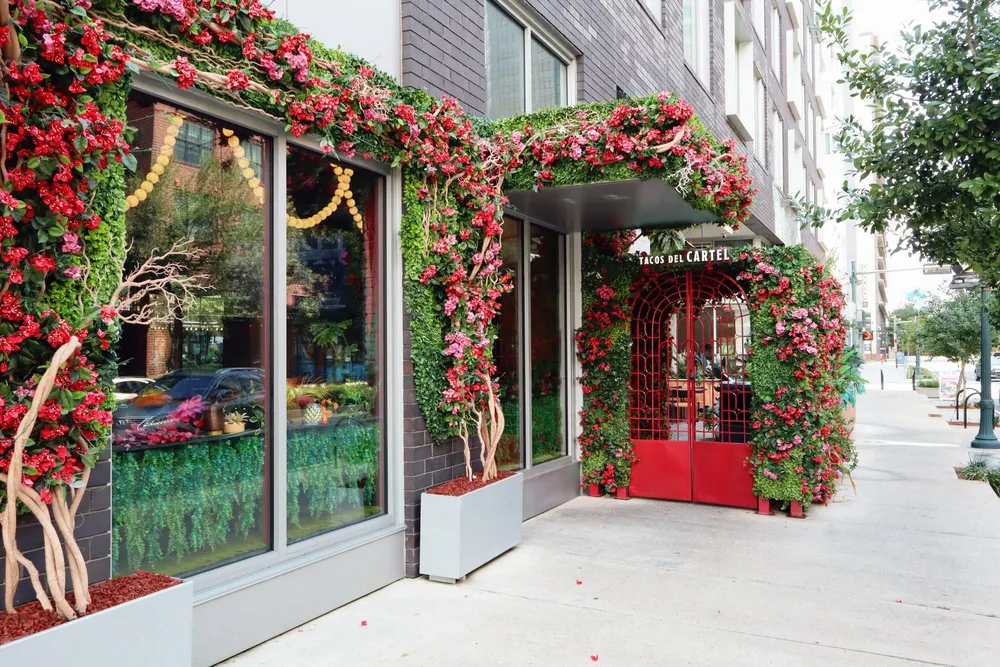
| 35,506 | 1010 Girod St. | Harris | TDC South Markets (Tacos Del Cartel) | Planters, booths, topiary, trellis | 288 sq ft | $1,535 | 20-year air-rights lease |
| 35,507 | 2816 St. Louis St. | Harris | Brandon Webb | Balcony | 94 sq ft | $192 | Perpetual servitude |
| 35,508 | 6 Newcomb Blvd. | McCarron | James Lapeyre III | Fence | 244 sq ft | $1,661 | Perpetual servitude |
| 35,509 | 10 Newcomb Blvd. | McCarron | James Lapeyre III | Fence | 128 sq ft | $870 | Perpetual servitude |
| 35,510 | 1660 N. Roman St. | Green | The Black School, Inc. | Fence | 147 sq ft | $440 | Perpetual servitude |
| 35,511 | 221 Royal St. | King | 221 Royal, LLC | Balconies | 117 sq ft | $1,518 | Perpetual servitude |
Several of these formalize what already exists or is being built under permit. The fence at 1660 North Roman Street, for the arts nonprofit The Black School, sits in the right-of-way to give an accessibility ramp its required clearance. The two Newcomb Boulevard fences belong to the same owner on the same block.
What the public gets in return
This is where the eight items stop being paperwork. The owner does not buy the public space. The agreement grants a defined right to use it, and in exchange the City sets a yearly payment in the ordinance. Taken together, the eight first-year payments come to about $7,654, each one rising by 15 percent every five years for as long as the agreement lasts.
Eight small agreements, most of them for a fence or a balcony, set about $7,654 a year in payments the City would not otherwise collect.
There is no flat rate per square foot. The payments run from $192 for the St. Louis Street balcony to $1,661 for one Newcomb Boulevard fence, and the effective rate ranges from roughly $2 to roughly $13 per square foot depending on where the property sits. The two Newcomb fences, same owner and same block, are priced identically per foot. The French Quarter balconies on Royal Street carry the highest rate. The number reflects an appraised value tied to location, not a formula a reader can apply from the agenda.
The eight also split into two legal forms, which answers a question a homeowner might ask: does the servitude stick to the property? For the three commercial projections, at the Roosevelt-area garage, the Prytania Street hotel and the Girod Street restaurant, the City used a 20-year lease of air rights. For the five fences and balconies, it used a predial servitude that runs in perpetuity, is recorded in the Orleans Parish land records, and transfers automatically to the next owner if the building is sold. In both forms, the City keeps the right to reclaim the space, on notice, if it later needs the right-of-way for a public purpose.
One of those three leases does not match its own file. For 1525 Prytania Street, the signed lease of air rights sets a 20-year term, while the legislative summary that routed the ordinance to the Council answers the question of duration with a single word: perpetual. The City's paperwork describes the same agreement two ways, and the record does not resolve which term governs.
Reading the agenda line yourself
Once decoded, the boilerplate is legible. When an agenda says the Council will "grant a servitude to an adjacent property owner for encroachments on/over portions of public right-of-way," read it as this: a private owner is asking for legal permission to keep part of a building, or a structure, in space the public controls, and the City has attached a price to it.
The record is public. Each ordinance, with its price, its term and the signed agreement attached, sits in the Council's legislation system on Legistar, and the meeting itself is archived on Granicus.
One word, a larger question
Servitude is the kind of word that disappears into an agenda. It sounds technical, the items look routine, and several can move together without much notice. Behind it is a plain public question the City answers property by property: when private use reaches into public space, on what terms should the City allow it, and what should the public collect in return? On August 20 the question came up eight times at once, for a fence, a few balconies, a hotel awning and a taco stand's planters, and for a little under eight thousand dollars a year.
Kim M. Braud is the Founder & Editor of Evans Cutchmore Press, an independent newsroom covering Louisiana and the Gulf South. Her reporting focuses on government accountability, infrastructure, business, culture, and the public policies that shape communities.
© 2026 Evans Cutchmore Press. All rights reserved.