
CULTURE, HISTORY & PRESERVATION
French Quarter folklore says the iron spikes were installed to keep young suitors from climbing onto balconies. Their resemblance to restraints once forced upon enslaved people raises a more complicated question, but the historical record does not yet provide a simple answer.
By Kim M. Braud | September 7, 2026
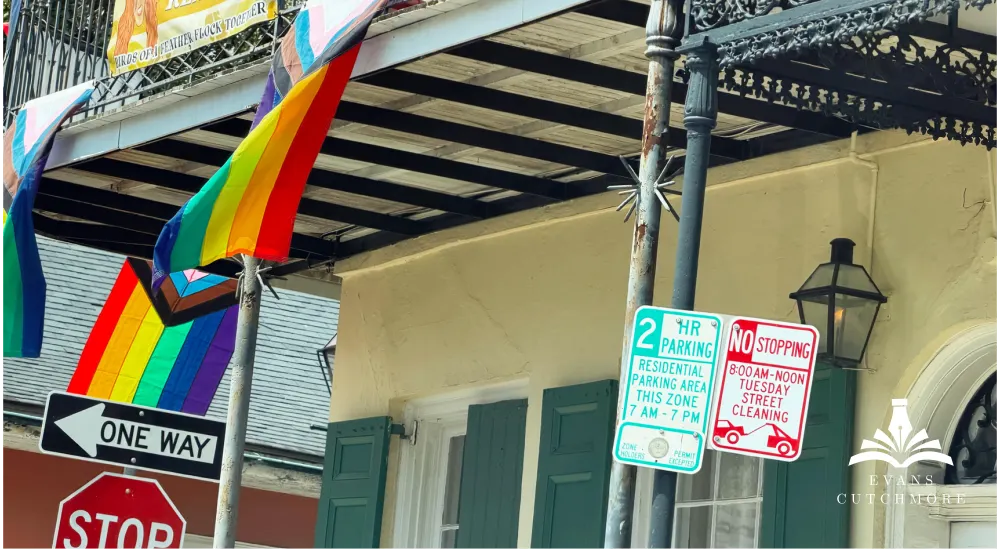
Across the French Quarter, sharp iron projections circle the columns supporting some of the neighborhood's galleries. They are commonly called "Romeo spikes" or "Romeo catchers," names attached to a story repeated on walking tours and across social media: protective fathers supposedly installed the spikes to prevent young men from climbing the columns at night to visit their daughters.
In the more gruesome versions of the legend, a fleeing suitor becomes impaled while attempting to descend from a balcony. The details change depending on who tells the story, but the central explanation remains the same. The spikes were there to stop New Orleans' would-be Romeos.
It is a memorable story. It may not be history.
There appears to be little contemporary documentation establishing when the spikes were installed, who ordered them or whether deterring romantic visitors was ever their intended purpose. Despite the confidence with which the story is often repeated, the familiar name and explanation may be folklore applied long after the ironwork appeared.
Looking closely at the spikes raises another question. Their shape bears a striking resemblance to the projecting iron bars attached to some punishment collars forced upon enslaved people. Were the architectural spikes related to those restraints, adapted from them or produced through the same ironworking tradition?
The resemblance is real. A direct historical connection, however, has not been established.
What is documented
Iron collars were among the restraints used to punish, control and publicly humiliate enslaved people. Some incorporated long iron projections, bells or both. The projecting bars restricted movement, caught on trees and brush and made it more difficult for a person to escape or conceal themselves.
The Historic New Orleans Collection identifies the forced wearing of heavy iron collars among the horrific punishments imposed on people who resisted slavery. Its "Purchased Lives" exhibition includes an iron-and-brass slave collar with bells dated between 1800 and 1865. Runaway advertisements in antebellum newspapers also described people who escaped while still wearing iron collars, providing contemporary evidence that the devices were used in Louisiana and elsewhere in the South.
The collars were not merely restraints. Their design extended punishment beyond the weight of the iron around the neck. The projections interfered with movement and rest, while bells could alert others to the wearer's location. The device turned the surrounding environment into another means of confinement.
That history is documented through surviving artifacts, newspaper advertisements, abolitionist material and firsthand accounts.
The history of the devices now called Romeo spikes is much less certain.
A romantic explanation without a clear record
The popular explanation presents the spikes as a form of domestic security specifically aimed at young men seeking access to women living above the street. Yet the phrase "Romeo spikes" itself does not prove that this was their original name or purpose. It may instead represent a later interpretation of ironwork originally intended as a general climbing or intruder deterrent.
Independent New Orleans tour researcher Christy Vega examined the legend and reported that she could not locate contemporary newspaper references explaining the spikes. Her comparison of archival photographs also indicated that at least one set was added to a building sometime between 1965 and 1975, demonstrating that not every example necessarily dates to the original construction of the building on which it now appears.
That finding complicates any attempt to give all of the spikes a single origin story. Some may be historic. Others may be reproductions, replacements or later additions inspired by spikes seen elsewhere in the Quarter. Without examining the construction history of each property, it is difficult to determine whether the existing examples belong to the same period or were installed for the same reason.
The resemblance is real. A direct historical connection, however, has not been established.
The buildings themselves do not settle the question. Although the French Quarter is widely associated with the colonial era, much of its surviving architecture is younger. The Preservation Resource Center, citing architectural historian Robert Cangelosi Jr., reports that the Quarter's fires of 1788 and 1794 destroyed much of its earlier built environment and that a significant portion of its surviving buildings dates to the 19th century.
That places at least some of the architectural ironwork within the same broad century in which iron collars and other instruments of enslavement were being used in Louisiana. It does not prove that one design produced the other, but it makes the comparison historically relevant rather than purely visual.
Did one design become the other?
At present, there is no documented basis for saying that spikes were removed from buildings, copied from buildings or otherwise transferred for use on enslaved people. The available chronology does not support presenting the punishment collars as a later adaptation of the so-called Romeo spikes. Spiked and projecting restraints used against enslaved people were already documented during the antebellum period, while the dates of many surviving architectural spikes remain uncertain.
It is also possible that no direct transfer occurred in either direction. Blacksmiths have long used spikes as a straightforward way to prevent access or movement. Similar forms can emerge when different objects are designed around the same principle: make passage physically difficult and potentially painful.
Nevertheless, the resemblance forces a reconsideration of the language used to describe the French Quarter fixtures. "Romeo spikes" transforms a threatening piece of iron into a charming fragment of local romance. It gives visitors a story about courtship, protective fathers and secret balcony visits while directing attention away from the broader culture in which iron barriers, restraints and punishments were commonplace.
New Orleans folklore frequently mixes fact with embellishment. Repetition then gives the story an appearance of authority, particularly when the same account appears on multiple tours, blogs and social-media posts. What remains unclear is whether the Romeo story preserves any authentic memory of the spikes' use or simply supplies a marketable explanation for an object whose history had already been forgotten.
An unanswered question in plain sight
The visual connection between the architectural spikes and punishment collars should not be presented as a proven historical link. Doing so would replace one unsupported story with another. But the absence of proof does not mean the question should be dismissed.
Determining the spikes' history will require property-by-property research. Building records, historic photographs, succession documents, ironwork contracts, restoration files and Vieux Carré Commission archives could help establish when individual sets appeared. Evidence identifying the foundries or blacksmiths that produced them could reveal whether their designs were part of a larger ironworking tradition.
Until that documentation is found, the most accurate answer is also the least theatrical: the spikes resemble projecting irons used on restraints imposed upon enslaved people, but no evidence located to date establishes that one was adapted from the other.
What the evidence does establish is that the history of iron collars belongs to New Orleans and Louisiana, not as legend but as documented fact. The history of the "Romeo spikes" remains unsettled.
The next time someone points toward a French Quarter gallery and tells the familiar story about fathers protecting their daughters, the proper response may not be to repeat the legend.
It may be to ask who first called them Romeo spikes, and what history that name allowed the city to forget.
Kim M. Braud is the Founder & Editor of Evans Cutchmore Press, an independent newsroom covering Louisiana and the Gulf South. Her reporting focuses on government accountability, infrastructure, business, culture, and the public policies that shape communities.
© 2026 Evans Cutchmore Press. All rights reserved.