
NEWS
Friends, colleagues and council members remembered the historian, author and French Quarter tour guide, who died in August at 57, as the person everyone called when they needed the city's LGBTQ+ history.
By Kim M. Braud | October 2, 2026
NEW ORLEANS - The New Orleans City Council on Thursday adopted a resolution honoring the late Frank Perez, the historian, author, tour guide and French Quarter personality who spent nearly two decades documenting the city's LGBTQ+ history.
Resolution R-26-422, introduced by Council President JP Morrell, passed six to zero. It came before the council on Oct. 1, the first day of LGBTQ+ History Month.
Perez died Aug. 8 after a brief illness with cancer. He was executive director of the LGBT+ Archives Project of Louisiana, a former editor-in-chief of Ambush Magazine, a 2018 Grand Marshal of Southern Decadence, and a 2021 candidate for the District C council seat.
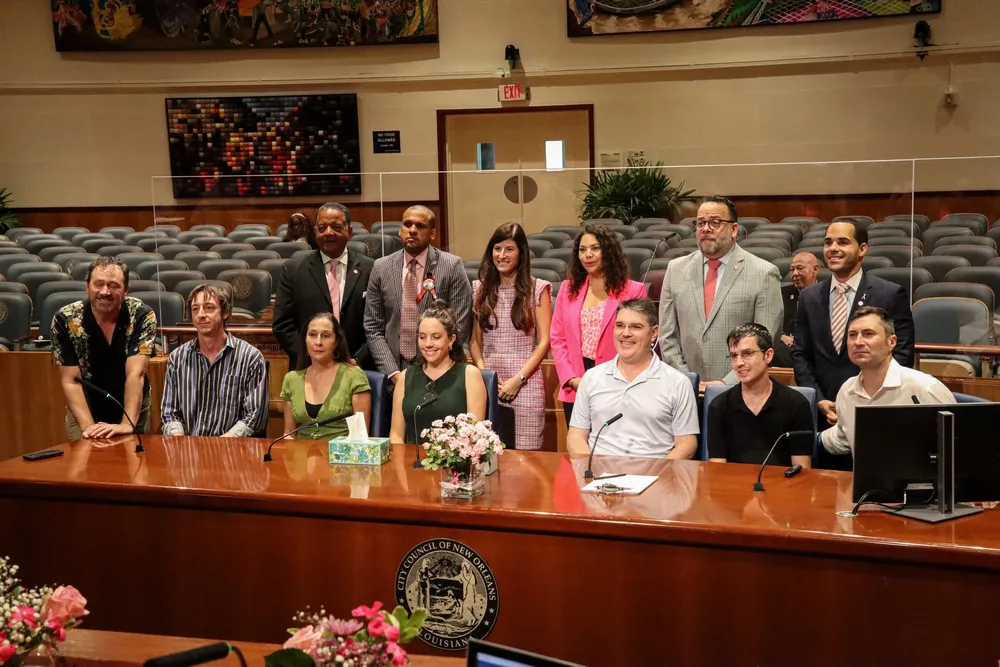
Friends filled the table before the dais. The longest tribute came from Bobby, a writer whom Perez mentored and who described himself as one of many people Perez had "discipled."
"Frank Perez answered"
Bobby opened by describing the role Perez played for anyone researching queer New Orleans.
"It is so fitting that we gather here now on the first day of LGBT+ History Month to honor our fellow citizen and pal Frank Perez, who proudly served as the first point of contact for the LGBT+ community of New Orleans," he said.
"If you were a journalist, or a filmmaker, or a student, or a tourist, or even an inquisitive member of this council wanting to know something about wild customs like Southern Decadence, or the tragedy of the 1973 Upstairs Lounge fire, or any aspect of queer New Orleans history and culture, you emailed and called around to shots in the dark, and Frank Perez answered."
He described Perez as "fun, affable, full of stories, supportive and at your service." Perez didn't seek that unofficial role and was mostly unpaid for it, Bobby said. "He was a non-materialist, happy to devote himself to a mission, and his passion for this city was infectious."
Bobby said he came to New Orleans in 2014 hoping to write his first history book. He met Perez at what Perez called his office: the back of the bar at Café Lafitte in Exile on Bourbon Street. The interview turned into an afternoon of Miller High Life and an unplanned, free tour of the French Quarter.
"In one afternoon, Frank Perez made me love New Orleans as completely as he did," Bobby said.
Perez went on to help him become a published author, sharing storytelling techniques and material from his private archives. When the book did well, Bobby said, "he accepted no credit, no credit."
"I moved here in 2018 to try to be more like this man," he said. He called Perez a "street king in a straw hat" who "could introduce you from high to low, from public officials to Quarter derelicts, easily and never with judgment. He was the soul of New Orleans to me and many."
If you wanted to know any aspect of queer New Orleans history and culture, you called around to shots in the dark, and Frank Perez answered.
From Baton Rouge to "Freedom at Last"
Bobby then walked the council through Perez's life.
Francisco Frank Earl Perez was born in 1968 and grew up in Baton Rouge. Bobby said he was kicked out of the Cub Scouts for being "a general negative influence." His mother was a career educator who taught remedial math by using sports statistics. His father was an attorney who taught him to spot logical fallacies and win arguments.
His childhood hero was Huey Long. "He loved Huey because the guy told stories, he helped the needy, and he didn't expect perfection," Bobby said.
Perez played high school football and served as a page in the Louisiana Legislature. Bobby said the best tour Perez ever gave was at the State Capitol, where he reconstructed Long's 1935 assassination, point by point, in the hallway where it happened.
Perez joined Sigma Pi at LSU before flunking out. He transferred to the University of Louisiana at Lafayette, where he earned a bachelor's degree in criminal justice in 1991 and a master's in English in 1997.
While active in campus ministry, Bobby said, Perez was publicly outed as gay and sent to a conversion therapy camp in Kansas called "Freedom at Last." There he befriended a young man named Eddie, who was dying of AIDS. Eddie introduced him to the films of Bette Davis.
When Eddie died, Perez was made to call the family. They told him, "We don't have a son."
"This was the moment that defined Frank's life," Bobby said. "Why live for the approval of others, he told me, if they'll do that to you."
Perez left the camp and enrolled in doctoral studies at Texas Christian University in Fort Worth. He became a tenure-track community college professor in Texas. In Bobby's words, he "educated thousands while perfecting the fine art of doing a day's work from a bar stool." Bobby also asked that one Texas detail go into the record: Perez held a local Irish pub's record of 34 pints of Guinness in a single sitting.
Perez later left academia for what Bobby called a freewheeling phase, including card counting, which produced some of his best stories.
"This city, which embraces the stranger"
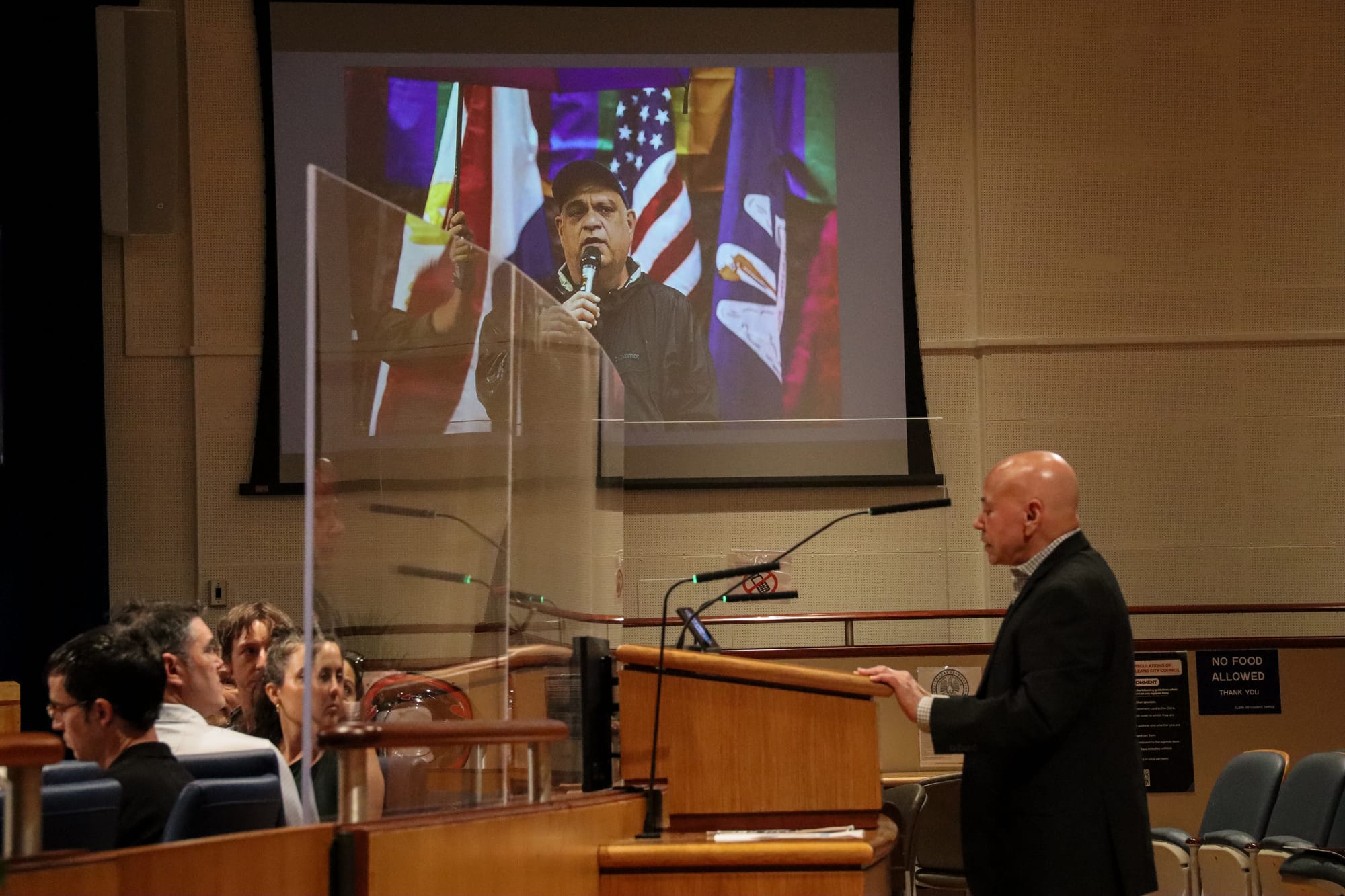
Perez moved to New Orleans shortly after Hurricane Katrina. Bobby quoted a 2023 oral history interview: "I thought I've got to get back to New Orleans, even though I had never, up to that point, fully lived in New Orleans."
"Just as Frank helped rebuild the city, this city, which embraces the stranger, helped Frank mature and ripen," Bobby said.
In 2012, Perez co-authored In Exile, a history of Café Lafitte in Exile, with Jeffrey Palmquist, who attended Thursday's meeting. He began writing a weekly history column for Ambush Magazine at the invitation of its founding editor, who became his mentor, and he later led the publication as editor-in-chief.
In 2014, he co-founded the LGBT+ Archives Project of Louisiana, which Bobby said was meant "to help get our queer history out of the closet." That same year, Perez began hosting an annual Twelfth Night party marking the start of gay Carnival season, at which he presided as Lord of Misrule.
Bobby said Perez published more than six history books in the last 15 years of his life. One, Political Animal, received an honorable mention for a 2024 Louisiana literary award. His final book was published by LSU Press. "Though he flunked out of LSU," Bobby noted. "Such a Frank move."
Perez ran for the District C council seat in 2021, finished third, and immediately befriended the winner, Councilmember Freddie King III. "He deeply respected this institution," Bobby said, adding that Perez loved that the chamber keeps a piano for musical public comment. "He viewed you as colleagues in the trenches."
Bobby described Perez's 12-year relationship with his partner, Chris, as the constant of his later life. When Perez was inducted into the Saints and Sinners Literary Festival Hall of Fame, Bobby said, he named his two proudest achievements: his love for Chris, and his 800-word history column for Ambush.
Bobby added a few more items for the record. Perez was a Beatles fan whose favorite was John. He was a Star Trek fan whose captain was James T. Kirk. His dinner parties brought together "all segments of New Orleans society, from sex workers to court judges," and featured a picadillo made from a family recipe Bobby never managed to get.
"They used to throw us in jail"
Bobby last saw Perez on Thursday, Aug. 6, two days before his death. He told Perez the council might say a few nice things about him.
Perez exhaled, thought about it, and answered: "Actually, that's pretty nice. They used to throw us in jail."
Bobby closed by placing Perez among New Orleans' great characters, real and fictional, from Tennessee Williams to Ignatius J. Reilly and Blanche DuBois.
"Rest in rainbows and rest in cocktails," he said. "Though you were not a child of New Orleans, you became a son of this city, and that is unquestionably your greatest achievement."
Though you were not a child of New Orleans, you became a son of this city, and that is unquestionably your greatest achievement.
"Do you think my life's work mattered?"
Tommy Acosta, owner and publisher of Ambush Magazine, said Perez's council run started with an offhand remark at dinner. Perez was complaining about something in the city, and Acosta told him he should run.
"I said, 'Frank, you're level-headed. You got some common sense. You're not a politician. You'd be perfect,'" Acosta recalled. Months later, Perez called asking for a campaign check. "So that became a very expensive dinner," Acosta said. Perez, he said, "loved every minute of it, and he'd never do it again."
Acosta visited Perez two days before he died and called it "20 of the most beautiful minutes I've ever spent with a human." Near the end of that visit, Perez asked him, "Do you think my life's work mattered?"
Acosta told him it did. "It is the fate of every man to die," he told the council. "It is not the fate of every man to be a pillar of a community, and that is what Frank was."
Eugene "Guy" Lamoth, president of the board of the LGBT+ Archives Project of Louisiana, thanked the council on behalf of the organization Perez co-founded and led.
A friend introduced from the dais as "Uncle Larry" spoke last. He said inclusion was at the core of Perez's work. Perez's Twelfth Night party, he said, began in his home in 2014 and within three years had to move to the Mardi Gras Museum on Rampart Street.
Last December, Larry called Perez to congratulate him on the first Ambush holiday cover to feature a lesbian couple. Perez's immediate reply, he said, was to ask whether Larry knew a Black or brown couple who would be willing to appear on the cover for Christmas 2026. "Always looking to the future," Larry said.
The council's remarks
Morrell read a statement from King, who could not attend due to a conflict. King described Perez as the most unusually gregarious opponent he had faced, one who spent more time befriending his rivals than running against them. He also called Perez a voice for French Quarter residents who were reluctant to raise problems themselves.
Morrell said Perez and Bobby drove much of his office's early work on behalf of the queer community, including a City Hall memorial for victims of the Upstairs Lounge fire.
"Frank is somebody who was not just a storyteller; he was a truth teller," Morrell said. "It's very easy for people to tell stories that are convenient truths, but it's very hard to find someone who can tell compelling stories about inconvenient truths and make you talk about things you don't want to talk about."
Frank is somebody who was not just a storyteller; he was a truth teller.
He said that every year, Perez would call his office when changes to the Southern Decadence parade route threatened the event, often within 72 hours of the parade, and then insist that no one know he had helped. "He might be the most humble person I've ever known," Morrell said. Morrell also told the room that he, too, had been kicked out of the Cub Scouts.
District D Councilmember Eugene J. Green Jr. said that while many people came to New Orleans after Katrina to make money, Perez came to help rebuild and promote its culture. "Frank Perez is an example of the diversity in our city that makes us special," Green said.
District A Councilmember Aimee McCarron read a statement from Perez's friend Mamie, who first met him through the tour-guiding classes he taught. She called him a mentor, educator, storyteller and member of her "family of choice."
District B Councilmember Lesli D. Harris said Perez had invited her on his tour, and she kept postponing it. "Gay history cannot be forgotten history," she said. "We're forgetting that 10 years ago you couldn't get married in Louisiana. We're forgetting that 30 years ago you had to meet in secret."
Vice President Matthew Willard said he met Perez during the 2021 campaign. "He was good for a laugh, he was good for a smile, and he was good for a story," Willard said.
The council then adopted the resolution and came down from the dais to present it to Perez's family and friends.
Where to verify
Resolution R-26-422 appears as item 37 on the agenda for the Oct. 1, 2026 regular meeting. The agenda, resolution text and meeting video are available through the council's Granicus archive at council.nola.gov.
Additional photos of the event can be viewed on our GALLERY
Kim M. Braud is the Founder & Editor of Evans Cutchmore Press, an independent newsroom covering Louisiana and the Gulf South. Her reporting focuses on government accountability, infrastructure, business, culture, and the public policies that shape communities.
© 2026 Evans Cutchmore Press. All rights reserved.