
NEWS ANALYSIS | NEW ORLEANS CITY COUNCIL
The City Council decides your property taxes, your streets, your zoning, and your Entergy rates. It does that in public, twice a month, on a schedule you can see coming. The distance between watching and taking part is smaller than most people expect: a comment card and two minutes.
By Kim M. Braud | August 4, 2026
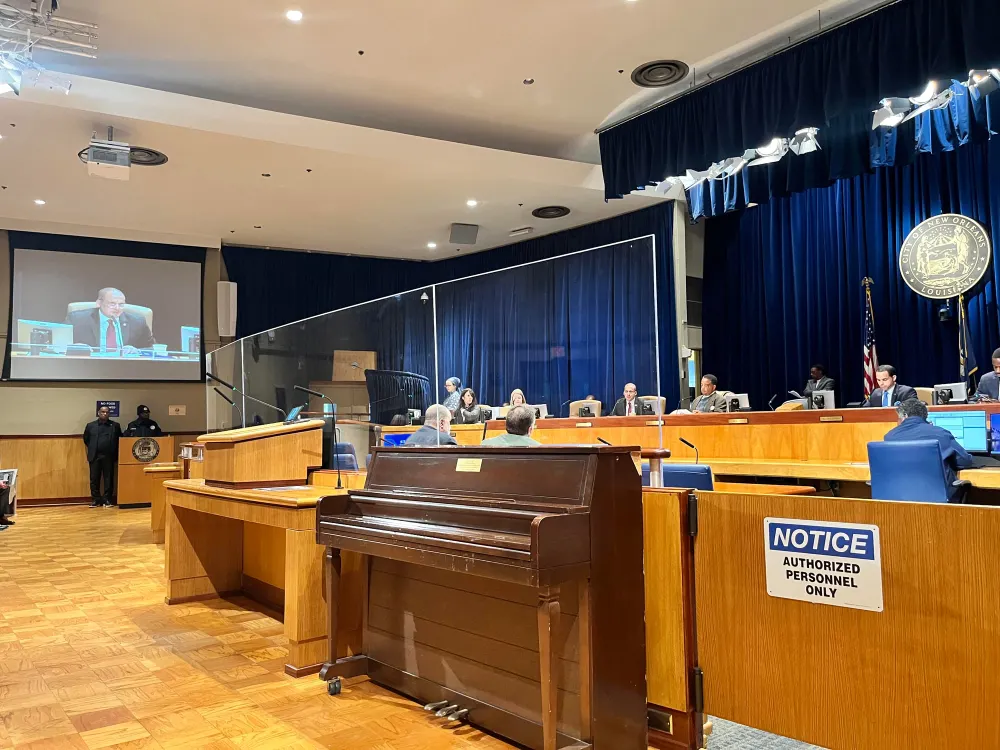
Most people picture a public meeting as a closed room where the decisions are already made. The New Orleans City Council chamber is more ordinary than that, and more open. The gap between sitting on the benches and putting your words into the official record is one short form and two minutes at a microphone.
What follows is what the body does, when it meets, and how a resident gets from the benches to the record.
What the Council actually decides
New Orleans runs on a Mayor-Council structure, and under the Home Rule Charter the legislative power sits with the Council, according to the Council's Citizens' Guide. Seven members hold it: five elected from districts and two elected at large. Jean-Paul Morrell is Council President and Matthew Willard is Vice President.
The list of what that body controls is longer than most residents realize. The Council adopts the city's operating and capital budgets. It sets and changes zoning, working with the City Planning Commission. It acts as the Board of Review for property tax assessments, which is where a homeowner appeals an assessment. It approves certain contracts and appointments.
And it does one thing almost no other city council in the country does. The New Orleans Council regulates the electric and gas utility, which means Entergy's rates are set at City Hall rather than by a state commission, as the Citizens' Guide explains.
These are the decisions that reach your tax bill, your block, and your power rate. They are made in a room you are allowed to walk into.
When it meets, and how to know what is coming
The Council holds two regular meetings a month, on a Thursday, in the Council Chamber at City Hall, starting at 10:00 a.m. That schedule is set in the Council's Rules and Regulations. The next regular meetings are Thursday, August 20 and Thursday, September 3.
Most of the detailed work happens earlier, in committee. Ten standing committees, from Budget to Quality of Life to Public Works, review matters first and send recommendations to the full Council. A committee cannot pass a law. It can only recommend, and the full Council decides.
The agenda is public before the meeting. Under the Council Rules, items must reach the Clerk of Council by noon three working days before a meeting, which for a Thursday session means noon on the Monday before. If something did not make the written agenda, it takes a unanimous vote to add it.
You do not have to be in the building to see any of this. The full meetings calendar and agendas are posted online, the Council streams live on its YouTube channel and on the city's Granicus video archive, and you can subscribe to email notices from the meetings page. To find which district you live in and who represents you, use the Where Y'At address lookup or the councilmembers directory.
How the room works
A regular meeting follows a fixed order set in the Rules: roll call, invocation, the pledge and anthem, approval of the minutes, communications, then the consent agenda and the regular agenda. Land use matters are not taken up before 11:00 a.m.
The consent agenda is worth understanding, because it is where routine items move fast. Non-controversial matters are grouped and adopted in a single vote to save time. Any councilmember can pull an item off the consent list and move it to the regular agenda for individual discussion, and any resident may still speak on a consent item.
If the meeting runs long, it does not simply end. Under the Rules, business not finished by 10:00 p.m. recesses to 9:00 a.m. the next morning.
How to actually speak
This is the part residents ask about most, and the answer is short.
To address the Council on a non-land-use item, you fill out a comment card and be present in the chamber. Every person who has properly submitted a card gets called. You have two minutes per agenda item, and you cannot hand your time to someone else. Those rules are in Rule 47 of the Council's Rules and Regulations.
Your comment has to be germane to the item on the agenda. If you have documents you want in the record, you bring them to the Clerk with eight copies. If you were paid or given anything of value to take your position, the Rules require you to say so at the microphone.
For land use items the format shifts slightly. Each matter gets up to twenty minutes of public comment total, and each speaker still gets two minutes.
There are also decorum rules that catch people off guard. Signs cannot be mounted on wood or metal, cannot be larger than eighteen inches, and cannot be held above shoulder height unless you are in the back row. You are not to call out from the benches unless the chair has recognized you.
The limits worth knowing
The process is legible and reachable on paper. In practice, a few features shape who actually reaches it.
A 10:00 a.m. start on a Thursday is difficult for anyone working a weekday job, which quietly narrows the room to people with flexible schedules, retirees, paid advocates, and reporters. The two-minute, single-item, germane structure keeps meetings moving, and it also means a resident's window is narrow and specific. And the consent agenda lets a stack of routine items pass in one vote, so a resident watching for a particular item has to know it is coming and be ready when it is called.
None of that is hidden. All of it is written into the Rules and the schedule. The record, the agenda, and the video are open, through the Public Records Act and the state's open meetings law. The system is more reachable than its reputation, and reaching it still takes knowing where the door is.
The essentials
- When: Two regular meetings a month, Thursdays at 10:00 a.m., Council Chamber, City Hall, 1300 Perdido Street.
- Agendas and calendar: council.nola.gov/meetings. Agenda is set by noon the Monday before a Thursday meeting.
- Watch live or after: YouTube @NOLACityCouncil and the Granicus archive, linked from the meetings page.
- To speak: Submit a comment card in the chamber, be present, two minutes per item, comments germane to the agenda item.
- Written material for the record: Deliver to the Clerk with eight copies.
- Records requests: nola.nextrequest.com.
- Find your councilmember: Where Y'At or the councilmembers directory.
- Clerk of Council: Aisha R. Collier, (504) 658-1085, clerkofcouncil@nola.gov.
Kim M. Braud is the Founder and Editor of Evans Cutchmore Press, an independent newsroom covering Louisiana and the Gulf South. Her reporting focuses on government accountability, infrastructure, business, culture, and the public policies that shape communities. Her work combines investigative journalism, public records research, and documentary storytelling.
© 2026 Evans Cutchmore Press. All rights reserved.