NEW ANALYSIS
Founded in 1938 and named for a Black physician who ran a free clinic in Algiers, Landry has survived a fire, a hurricane and a merger. NOLA Public Schools is holding community meetings this week on what comes next.
By Kim M. Braud | September 27, 2026
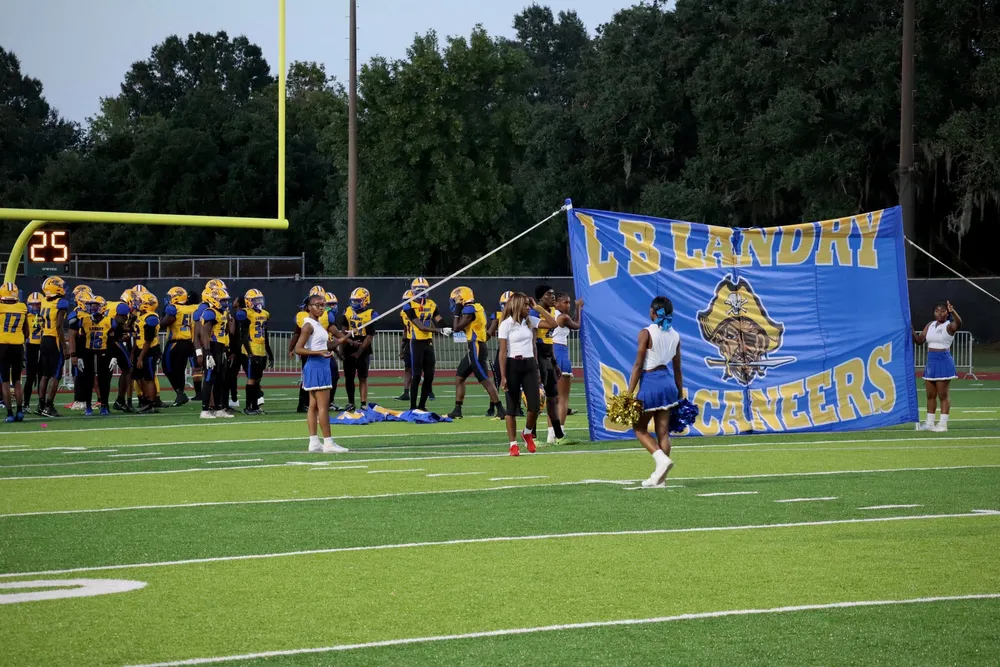
L.B. Landry High School has been rebuilt after a fire, reopened after Hurricane Katrina and absorbed another West Bank high school. Now the nonprofit that runs it has voted not to continue.
The Algiers Charter board voted Thursday, Sept. 24, not to seek renewal of its contract to operate Landry. The contract expires in June, The Times-Picayune reported. NOLA Public Schools said it must approve the board's decision before it becomes final. After that, the school board would decide whether to find another charter operator, run Landry as a district school, or close the campus, according to Fox 8. The district has said decisions will be made by Dec. 15.
Before then, the district is holding community meetings, the first of them at Landry on Monday. Details are at the end of this story.
The doctor behind the name
Lord Beaconsfield Landry was born in Donaldsonville in 1878 (some sources say 1879). His father, Pierre, was the town's first Black mayor. He graduated from Fisk University in 1902 and earned his medical degree from Meharry Medical College in 1908. At Fisk, he sang with the Fisk Jubilee Singers.
He built his practice in Algiers. He ran a free clinic, wrote a health column called "How to Keep Well" for the Louisiana Weekly, and served as a volunteer probation officer. He also directed the Osceola Five, a men's vocal group that performed Black cultural music at educational and religious programs. He died in 1934 of blood poisoning after accidentally cutting himself with a surgical knife.
According to the historical marker near the school, his clinic, his music and his probation work all shaped the decision to name a public school for him. The marker was put up by the Freddie Marshall Foundation and the L.B. Landry New Generation Historic Alumni Association.
A school for Black families on the West Bank
The school was dedicated on Oct. 26, 1938, as an elementary school, with Israel M. Augustine Sr. as its first principal. It became a full high school in 1942. It was the first school in Louisiana named for an African American. The firm that designed the current campus describes it as the first public high school on the city's West Bank that Black residents could attend.
The school kept changing shape as it grew. In 1952 it became the system's first combined junior and senior high school. A fire destroyed the main building in 1958, and it was rebuilt a year later. An annex added in 1969 brought 22 classrooms, an assembly hall and a theater.
The building is 16 years old. The question now is who will run the school inside it.
Katrina, a new campus and a merger
After Hurricane Katrina, the damaged school stood empty. The Landry community pushed for it to be chosen for rebuilding under the post-storm "Quick Start" program. The new campus opened in 2010 at a cost of $54 million, The Times-Picayune reported. It has a 1,000-seat gym, a 650-seat auditorium, and rehearsal rooms for dance, choir and band, along with a black box theater. It also includes a community health clinic designed to be open to the public after hours. That clinic operates in the same neighborhood where Dr. Landry ran his free one decades earlier.
Enrollment was already the concern. In a 2011 report to the state education board, the state projected about 2,455 high school students on the West Bank by 2016, against room for 4,089, a surplus of 1,634 seats. The state decided to combine Landry with O. Perry Walker High School.
Alumni fought the merger. In August 2012, Landry alumni sued the state in Civil District Court. They argued it had ignored a 2011 law requiring a community outreach plan before changing how a school is governed, and that it had unfairly labeled Landry low-performing. The merger took effect in fall 2013 on the Landry campus.
Enrollment and the vote
Algiers Charter told The Times-Picayune that Landry's enrollment has fallen 68% since 2014, and from about 750 students in 2021 to about 500 last year. Enrollment is falling across the city. The district has lost 3,000 students since 2020, according to estimates from New Schools for New Orleans cited by the paper.
In 2012, Landry alumni went to court arguing they had not been consulted. This time, the district has scheduled community meetings before it decides.
How to follow this
- Who decides: The Orleans Parish School Board must first approve releasing Algiers Charter from its contract. It then decides the school's future. The district says decisions will be made by Dec. 15.
- Community meetings: Monday, Sept. 28, 5:30 to 7 p.m., at L.B. Landry High School, 1200 L.B. Landry Ave. Thursday, Oct. 1, 5:30 to 7 p.m., at MLK Elementary, 1617 Fats Domino Ave.
- Next school board meetings: A committee meeting on Tuesday, Oct. 27, at 10 a.m. and a business meeting on Thursday, Oct. 29, at 5:30 p.m. Both are at 2401 Westbend Pkwy., Room 1050.
- Agendas: Posted on the district's Simbli eBOARDS portal.
- Public comment
- Your board member
Kim M. Braud is the Founder & Editor of Evans Cutchmore Press, an independent newsroom covering Louisiana and the Gulf South. Her reporting focuses on government accountability, infrastructure, business, culture, and the public policies that shape communities.
© 2026 Evans Cutchmore Press. All rights reserved.