
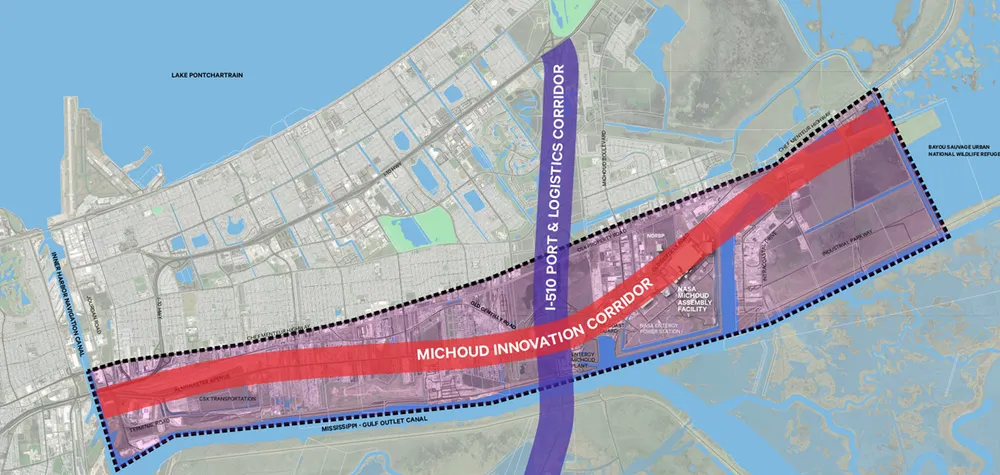
The City is organizing New Orleans East's economic development around a Michoud Innovation Corridor and a Port and Logistics Corridor. Here is a plain reading of the plan, the numbers behind it, and the public steps still ahead.
By Kim M. Braud | Evans Cutchmore | July 08, 2026
The City of New Orleans on July 8 announced the New Orleans East Investment and Job Corridors, a strategic economic development initiative the administration says will position the East as the Gulf South's leading destination for advanced industry, investment, and job creation.
The plan is organized around two corridors.
The Michoud Innovation Corridor is anchored by NASA's Michoud Assembly Facility and is meant to support aerospace, advanced manufacturing, research, technology, and innovation.
The Port and Logistics Corridor is built around the future Louisiana International Terminal and is meant to advance maritime commerce, logistics, transportation, warehousing, and supply chain industries.
Together, the City says, the corridors will attract private investment, create high-quality jobs, and strengthen demand for restaurants, retail, hotels, grocery stores, and neighborhood services across the East.
New Orleans East is home to roughly 60 neighborhoods and about 88,000 residents. It has carried the promise of large-scale investment for two decades, and it has also carried the disappointment of watching that investment stall.
The Michoud corridor is built on a real anchor
Michoud is not an aspiration. It is one of the largest manufacturing plants in the world, an 832-acre, NASA-owned campus that builds the core stages of the Space Launch System rockets and structures for the Orion spacecraft. The core stage for the Artemis II mission was built there.
By the numbers, Michoud already supports the kind of economy the corridor language describes. Greater New Orleans, Inc. puts employment on the campus at roughly 3,500 to 4,200 workers, with more than 5,000 jobs supported across Louisiana and Mississippi and roughly $630 million to $830 million in annual regional output.
Private construction has followed. Propel Park, developed by Industrial Realty Group inside the Michoud campus, is described by economic development officials as the first new industrial construction in the city in more than 20 years, with Textron Systems as its first tenant and up to 1.3 million square feet planned across phases.
The port corridor's anchor sits in the next parish
One point about the Port and Logistics Corridor is worth clarifying up front.
The Port and Logistics Corridor is anchored to the Louisiana International Terminal, Port NOLA's roughly $1.8 billion container terminal. It is a genuinely large project, a public-private partnership with Ports America and Terminal Investment Ltd., targeted for completion in 2028 and projected to handle about 2 million containers a year and to generate as many as 18,000 jobs by 2050.
But the Louisiana International Terminal is not being built in New Orleans East. It is being built in Violet, in St. Bernard Parish, roughly 10 miles downriver from the city. The jobs, tax base, and throughput it generates will be shaped by St. Bernard's geography as much as by New Orleans East's.
The port assets that actually sit in the East are older and smaller, clustered along Jourdan Road and the Inner Harbor Navigation Canal. Lineage's cold-storage complex there, expanded in a $42 million project a few years ago, is the kind of maritime and warehousing employer the East already has.
None of this makes the corridor framing wrong. The City's own map draws the Port and Logistics Corridor as a real band of New Orleans East land running along Interstate 510 and the Inner Harbor Navigation Canal down toward the Mississippi River-Gulf Outlet Canal, and the East will plausibly capture warehouse, distribution, and supply-chain demand generated by the terminal. But "built around" a $1.8 billion project in the next parish describes spillover and connectivity, not a project inside the corridor. The distinction matters for understanding where the terminal's jobs and tax base would actually land.
The governance behind the announcement
The corridors sit on top of an economic development structure the administration reorganized in June. Mayor Helena Moreno named Deputy Mayor of External Affairs Renee Lapeyrolerie as the administration's point person for New Orleans East economic development, and moved Jenny Mains from Deputy Mayor for Economic Development into a special advisor role focused on international partnerships.
In announcing the corridors, Moreno framed the initiative as coordination rather than a single new project. "What has been missing is a coordinated effort to prepare sites, improve infrastructure, recruit investment, and tell one compelling story to employers and investors," she said. "The New Orleans East Investment and Job Corridors bring those pieces together under one unified vision."
District E Councilmember Jason Hughes, whose district includes New Orleans East, tied the announcement to the area's long frustration with disinvestment, saying that "for far too long New Orleans East was the 'city of no'" and is now "open for business."
What the City actually committed to
The release names two immediate priorities, both of which are process rather than construction.
The first is development-ready sites and infrastructure. The City says it will identify strategic sites, assess utility capacity, improve roads, address zoning barriers, and build an inventory of shovel-ready properties, work it describes as complementing the existing EAST Task Force. The one hard dollar figure attached to the rollout lives here: a joint $20 million grant application to the U.S. Economic Development Administration, filed with Entergy New Orleans, to fund utility improvements. That is a request, not an award. Whether the EDA funds it, and at what level, is not yet known.
The second priority is investment attraction. Working with Greater New Orleans, Inc., the City says it will market the East nationally and internationally, recruit employers and developers, and build partnerships. Delgado Community College is named as a workforce partner, with Chancellor Larissa Littleton Steib pointing to the college's existing programs in maritime, logistics, aerospace, and advanced manufacturing as a match for both corridors.
What is still unanswered
The release moves the story from a social-media caption to an official plan with named partners. But the numbers that would make it a funded program are still missing.
No committed private investment is named, and no dollar figure or jobs count is attached to the corridors themselves, as distinct from the Michoud and terminal projects that predate them.
No timeline is given for the site inventory, the infrastructure work, or the marketing push.
The $20 million is contingent on a federal grant the City does not yet hold.
By the administration's own description, much of the initiative coordinates efforts already underway, through the EAST Task Force, Port NOLA, GNO Inc., and private developers at Michoud, and packages them under a single plan. The release does not identify new city funding attached specifically to the two corridors beyond the pending federal application.
New Orleans East has been the subject of redevelopment plans before, which is part of why residents track them closely.
How to follow this
Because the corridors depend on public steps, most of the decisions ahead will happen in open meetings.
Zoning and land use. Any rezoning to clear the "zoning barriers" the City references would move through the City Planning Commission and then the City Council, both of which take public comment before voting.
Council oversight. New Orleans East sits in Council District E, represented by Jason Hughes. Residents can raise site selection, infrastructure spending, and the corridors' progress through the district office and at regular Council meetings.
The federal grant. The $20 million for utility work depends on the U.S. Economic Development Administration acting on the joint application from the City and Entergy New Orleans. An award, or a denial, would be the next concrete marker.
Evans Cutchmore will continue to track meeting dates, the grant decision, and any named private commitments as they are scheduled.
Photo courtesy of City of New Orleans
Kim M. Braud is the Founder & Editor of Evans Cutchmore, an independent newsroom covering Louisiana and the Gulf South. Her reporting focuses on government accountability, infrastructure, business, culture, and the public policies that shape communities. Her work combines investigative journalism, public records research, and documentary storytelling.
© 2026 Evans Cutchmore Press. All rights reserved.