
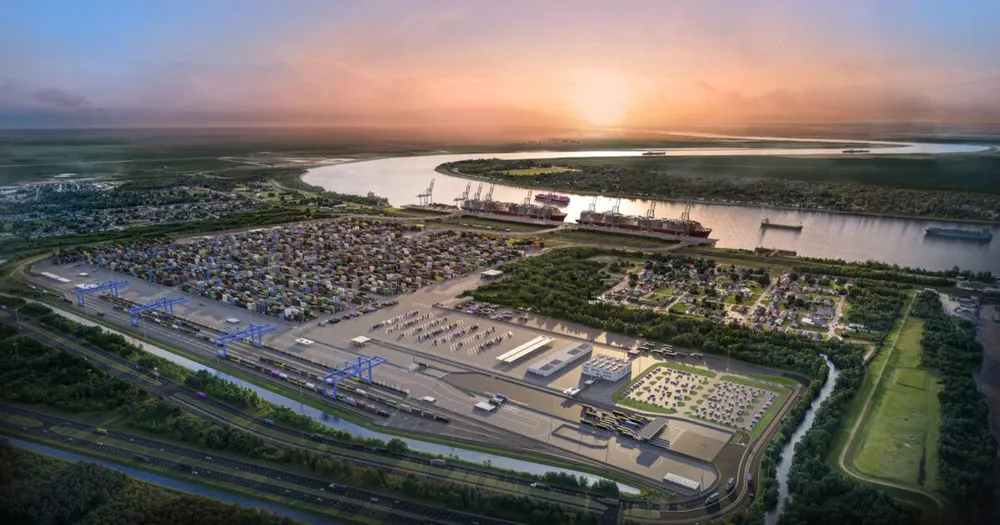
Port NOLA's planned container terminal in Violet is the anchor of the city's new Port and Logistics Corridor. Here is what it would build, who is paying, the jobs it promises, and why much of St. Bernard Parish is against it.
By Kim M. Braud | Evans Cutchmore | July 08, 2026
When the City of New Orleans launched its New Orleans East Investment and Job Corridors this month, it built the Port and Logistics Corridor around the future Louisiana International Terminal. That terminal, known as LIT, is the single largest project in the region's maritime future. It is also one of its most contested. And it is not being built in New Orleans, or even in Orleans Parish.
Here is a plain accounting of what LIT is, where the money comes from, and why the parish that would host it has spent five years trying to stop it.
What the terminal is
LIT is a new container terminal that Port NOLA plans to build on the Mississippi River at Violet, in lower St. Bernard Parish, roughly 10 miles downriver from New Orleans. The site sits below the Crescent City Connection, and that is the point of the whole project.
Port NOLA's existing container terminal, near Napoleon Avenue in Uptown New Orleans, sits above the bridge. Ships taller than about 166 feet cannot pass under it, which caps the Uptown terminal at vessels carrying roughly 6,400 to 9,400 containers. The largest container ships now in service are bigger than that, and they cannot currently reach New Orleans. Built below the bridge with no overhead restriction, LIT is the Port's answer. "Right now, the largest container ships can't get to Louisiana," Port NOLA chief executive Beth Ann Branch told residents at a 2025 hearing.
The Port projects that at full build-out, decades from now, LIT would handle about 2 million TEU a year, the industry's twenty-foot-equivalent measure, which works out to roughly 1.2 million actual containers. That capacity is not immediate. Phase 1, a single ship berth, is projected to open in 2028 and handle between 180,000 and 280,000 containers in its first year, with the rest of the terminal opening in stages over the following 25 years or so.
Who is paying
LIT carries a price tag of roughly $1.8 billion, a figure some recent accounts have put closer to $2 billion. As of early 2026, Port NOLA reported about $1.78 billion in funding commitments. The pieces, by the Port's own breakdown:
$800 million from the private operators, Ports America and Terminal Investment Limited, or TiL, the terminal arm of the Mediterranean Shipping Company.
$500 million from Port NOLA.
$226 million from a federal INFRA grant.
$180 million from the Louisiana Legislature.
$74 million from a federal MEGA grant.
The two private partners, organized as an operating group, would also run the terminal. Separately, the state has committed $50 million to design the St. Bernard Transportation Corridor, an elevated roadway meant to connect LIT to the interstate system at the I-510 spur in New Orleans East, with early construction money secured through Congress.
What the Port promises
The Port's case rests on jobs and tax base. Its statewide projections put LIT at 18,000 jobs in Louisiana, about 4,300 of them in St. Bernard Parish, and 32,000 nationwide, along with more than $1 billion in new state and local tax revenue by 2050. Officials frame the terminal as a way to give young people a reason to stay in the parish, and point to a training pipeline through Nunez Community College's maritime program.
In April 2026, with the permit decision expected, the project's backers sharpened that pitch for St. Bernard specifically. An economic and fiscal analysis prepared by GNO Inc., the regional development agency whose chief executive Governor Landry tapped to help move the project, projects that at full build-out LIT would add about $33.3 million a year to the parish's tax base, which it frames as a 58 percent increase over the roughly $57 million St. Bernard collected in 2024. It estimates 4,339 new direct and indirect parish jobs, a 37 percent increase, phased in over about two decades. The analysis breaks the projected annual property taxes down by recipient, with the parish school district receiving about $5 million, law enforcement about $5.1 million, the fire district about $2.5 million, and drainage and levee maintenance about $1 million.
Those numbers come from the project's proponents and describe a build-out that does not reach full scale until the 2040s. The analysis says it draws on a 2023 LSU-affiliated economic study, a 2025 fiscal forensics report, and IMPLAN input-output modeling, and it labels its own estimates conservative. They are projections, not commitments, tied to a terminal that is not yet permitted or built.
Why St. Bernard is fighting it
For all the state and federal backing, the terminal is deeply unpopular where it would be built. Opposition has organized under a group called Save Our St. Bernard, or SOS, which says its campaign has the backing of about 74 percent of the parish. Every one of the parish's elected officials has opposed the project since it was announced in 2021.
Residents' objections are consistent: thousands of trucks a day moving through the community, air and noise pollution, environmental damage to surrounding wetlands, and the loss of the parish's character. One resident told the Army Corps the project would reduce St. Bernard to "just a memory." One objection is literal and concrete. W. Smith Jr. Elementary School sits inside the terminal's proposed footprint. The Port says it is committed to funding a replacement school in Violet. Opponents also dispute the economic case itself, questioning whether parish residents rather than outside workers would fill the promised jobs, a doubt some voiced at the Corps hearings, and arguing that projected tax gains would not offset the daily disruption of thousands of trucks.
The fight has moved through several channels at once. The parish has filed lawsuits. Attorney Sidney Torres III has led court challenges, and opponents have said their best chance of stopping the terminal may be stopping the road, along with legal fights over land expropriation and environmental permits. The Parish Council commissioned its own port consultant, John Vickerman, whose report argued that a site 83 miles upriver poses navigation-safety concerns for the largest ships and that a location nearer the Gulf would serve the state better. Some residents filed a petition to recall Parish President Louis Pomes after he offered cautious support for the connecting road. Lieutenant Governor Billy Nungesser has sided with the opponents.
Underneath the specific objections is a longer memory. Opposition leaders point to the Port's history on the Industrial Canal and the Mississippi River-Gulf Outlet, the MR-GO, damage that many in St. Bernard and the Lower Ninth Ward associate with the flooding of 2005 and say was never repaired. When the Port says this time will be different, that history is what it is asking residents to look past.
Where it stands
LIT is stuck at the same point it has occupied for months: waiting on a federal permit. Because the terminal would be built on the Mississippi River, its levee, and adjacent wetlands, it needs approval from the U.S. Army Corps of Engineers under the National Environmental Policy Act. The Corps held public hearings in 2025 that drew standing-room crowds, most of them opposed, and has said it must identify the least environmentally damaging alternative before it can act.
Port officials had hoped the Corps would issue its findings by the end of the first quarter of 2026. As of mid-2026, no decision had been announced, and the Port still describes the permitting process as running through 2026. At its November 2025 State of the Port address, chief executive Beth Ann Branch pressed the urgency of the terminal while acknowledging that the timeline is out of the Port's hands. To help win over skeptical parish leaders, Governor Jeff Landry tapped Michael Hecht, chief executive of the regional development agency GNO Inc., to help shepherd the project.
Meanwhile, the competition has not stood still. The Plaquemines Port revived a deal with the Dutch operator APM Terminals to build a rival container terminal across the river, which raises the question of whether the Gulf South needs, or will support, two.
Why it matters here
The Port and Logistics Corridor that the City drew through New Orleans East is oriented toward this terminal and the road that would connect to it at I-510. That means the corridor's central premise, maritime and logistics growth flowing north into the East, depends on a project that is still unpermitted, still in litigation, and still opposed by the parish that would host it. The jobs and truck traffic the East is being asked to prepare for are contingent on decisions being made 10 miles downriver, and in a federal permitting office.
How to follow this
The decisions ahead are public.
The U.S. Army Corps of Engineers controls the permit that determines whether LIT is built. The project's docket and public comment run through the Corps' New Orleans District.
Port NOLA is governed by a board of commissioners whose meetings are open to the public, where the terminal's budget and contracts are approved.
In St. Bernard, the Parish Council and the roadway process are where the connecting corridor and local conditions are decided.
Evans Cutchmore will continue to track the Corps permit decision, the St. Bernard Transportation Corridor, and the competing Plaquemines proposal as they develop.
Photo credit: Port of New Orleans
Kim M. Braud is the Founder & Editor of Evans Cutchmore, an independent newsroom covering Louisiana and the Gulf South. Her reporting focuses on government accountability, infrastructure, business, culture, and the public policies that shape communities. Her work combines investigative journalism, public records research, and documentary storytelling.
© 2026 Evans Cutchmore Press. All rights reserved.