
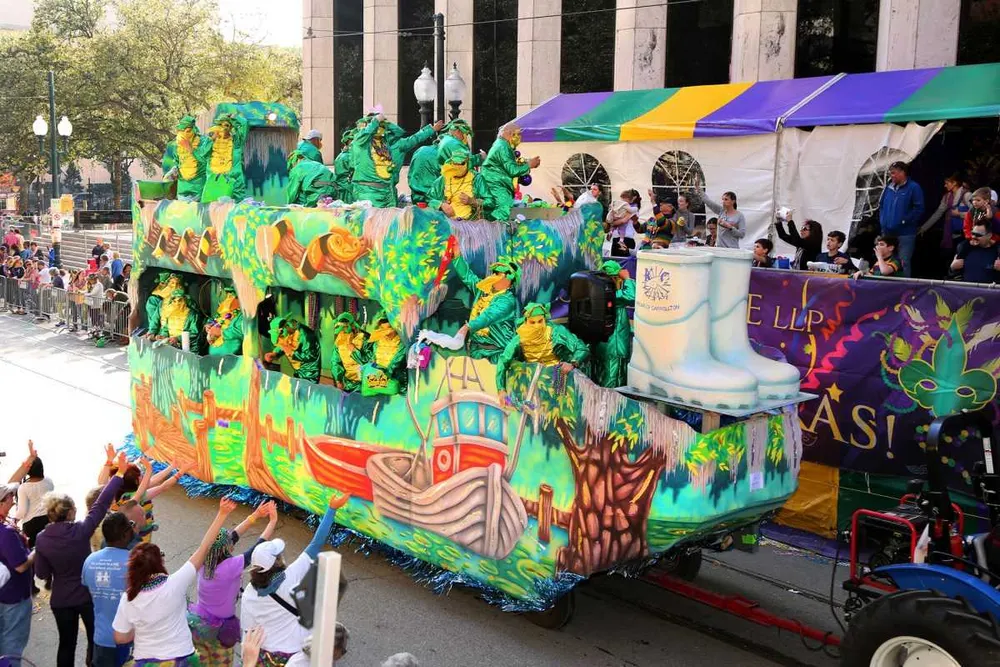
In New Orleans, it’s illegal for Mardi Gras float riders to show their faces. That’s not tradition, it’s a shield for racism that’s been hiding in plain sight for decades.
Ani Catherine | February 9, 2026
Yesterday, the Krewe of Carrollton made headlines when all riders on Float 10 were ejected from their parade after throwing beads “aggressively” at New Orleans police officers. Louisiana Attorney General Liz Murrill called it “absolutely appalling.” The incident sparked outrage. Float riders removed. Investigation launched. Accountability demanded.
But here’s what didn’t make headlines:
The reports from parade-goers, particularly Black families, that those same riders had been throwing beads AT people all afternoon. Not to them. At them. Aiming for heads. Throwing to hurt. Targeting children.
And the reports that when Black spectators reached up for throws, the riders simply didn’t throw at all.
This isn’t new. This is Mardi Gras. And there’s a law that makes it possible.
The Mask Mandate: Tradition or Shield?
In New Orleans, Mardi Gras float riders are legally required to wear masks. It’s not a suggestion. It’s not optional. It’s mandated by city ordinance and strictly enforced by krewes, with fines up to $500 per violation and potential removal from floats.
The official story? Masks preserve the “mystery” of Carnival. They allow riders to “mingle across social classes without recognition.” They’re a “core tradition” dating back over a century.
The reality? Masks let white riders discriminate with impunity.
Because when you’re masked, you can throw beads AT a Black child, and no one knows who you are.
You can refuse to throw to Black families and disappear into anonymity.
You can toss Confederate flag beads into a crowd and face zero consequences.
The mask doesn’t just hide your face. It hides your racism.
When Police Get Hit, It’s “Appalling.” When Black Kids Get Hit, It’s Tradition.
Let’s be clear about what happened yesterday with Krewe of Carrollton.
The New Orleans Police Department removed every rider from Float 10 after beads were thrown “intentionally and aggressively” at officers. The AG issued a statement. The media covered it. Accountability was swift.
But community members on social media reported something else: that float had been “crushing” spectators all afternoon. That riders were throwing heavy beads directly at people, not tossing them into crowds, but aiming. That Black families with children were being targeted.
Those reports didn’t trigger removal. Those reports didn’t spark investigations. Those reports were just another Sunday in New Orleans.
Because this is what Mardi Gras has always been: a celebration where violence against Black bodies is background noise, but violence against police is a crisis.
The Pattern That Never Makes Headlines
If you think yesterday’s incident was isolated, you haven’t been paying attention.
In 2016, a 5-year-old Black child caught Confederate flag beads thrown by a Krewe of Carrollton rider.
In 2020, education scholar Andre Perry wrote about his son catching Confederate flag beads from the same krewe, calling it a “teaching moment” about hate disguised as celebration.
In 2022, Confederate flag beads were thrown during the Krewe of Cleopatra parade, landing in the Gallier Hall viewing stands where city officials sit.
In 2018, a member of the Mystic Knights of Adonis threw a magnet depicting a racist caricature of a Black child with a watermelon to a 2-year-old.
In 2018, a 12-year-old Black girl was handed a doll “dressed like an enslaved person with a bead noose.” The krewe member who gave it to her said: “That’s you.”
These aren’t anomalies. These are features.
And when Clara Simpson, a New Orleans native who grew up in the 1930s and 40s, described Mardi Gras during segregation, her testimony sounds exactly like what Black families report today:
“When they saw a group of white people, they would always throw them beads, but if you were black, maybe you would only leave with one or two because they would never throw them to you.”
The law desegregated the krewes in 1992. But the masks never came off.
And the discrimination never stopped.
The Legal Irony: Masks Are Illegal , Except When They Protect Racism
Here’s the legal framework that makes this possible:
Louisiana state law (RS 14:313) generally prohibits masks in public. Wearing a mask in public spaces is illegal, unless you’re celebrating Mardi Gras.
During Carnival season, the rules flip.
Masks become mandatory for float riders. Krewes enforce this with fines, removal from floats, and expulsion from organizations. Police can halt entire parades if riders unmask.
The stated reason? Tradition. Mystery. Equality across social classes.
But let’s examine what this “tradition” actually accomplishes:
Without masks: A rider who throws Confederate flag beads to a Black child can be identified, reported, and held accountable by name.
With masks: That same rider is anonymous. Protected. Untraceable.
Without masks: A rider who systematically refuses to throw to Black families can be called out, filmed, and named publicly.
With masks: That behavior blends into the crowd of masked riders, indistinguishable and unaccountable.
Without masks: Patterns of racist throwing can be tracked to specific individuals and organizations.
With masks: Patterns disappear into “krewe culture” and “Carnival tradition.”
The mask mandate isn’t preserving mystery. It’s preserving plausible deniability.
“Mingle Across Social Classes” , But Only If You’re White
The official narrative around Mardi Gras masking is that it creates equality. That it suspends social hierarchies. That behind the mask, everyone is equal.
That’s a lie rich white people tell themselves. Because the truth is this: Mardi Gras has never been equal.
When the Mystic Krewe of Comus, the first organized Mardi Gras parade, formed in 1857, Black people were excluded entirely. Not just from riding. From attending.
After the Civil War, Comus remained “closely tied to the ideals of the Confederacy” and put on a parade in 1873 that mocked Reconstruction and depicted racist caricatures of Black Americans.
When Dorothy Mae Taylor introduced an ordinance in 1991 requiring krewes to desegregate or lose their parade permits, the oldest and most elite krewes, Comus, Momus, and Proteus, chose to stop parading rather than integrate.
They would rather end their parades than allow Black people to ride. And when krewes did finally integrate after the 1992 ordinance, many did so “begrudgingly,” as one historian noted.
The masks didn’t create equality. They preserved inequality while making it invisible.
The Krewe of Carrollton’s Confederate Problem
Krewe of Carrollton’s name keeps appearing in reports of racist throws.
2016: Confederate flag beads thrown to a Black 5-year-old.
2020: Confederate flag beads caught by a Black child.
2026: Aggressive throwing that targeted spectators before escalating to police.
This isn’t coincidence, this is pattern. And the krewe has never issued a public statement addressing its repeated connection to racist incidents. No policy changes. No accountability measures. No acknowledgment that their riders keep showing up in stories about Confederate imagery and violent throwing.
Just masks, and silence.
When Accountability Only Comes After You Hit the Wrong Target
Here’s what’s most revealing about yesterday’s incident:
Those riders were reportedly throwing aggressively at spectators, including Black families and children, for hours.
No one stopped them. No one removed them. No one called it “appalling.”
But the moment beads hit police officers? Immediate ejection. AG statement. Investigation launched.
The message is clear: Violence against Black parade-goers is acceptable. Violence against police is not.
And the mask makes it possible for riders to know exactly which is which, because they can target with precision, hurt with intention, and disappear into anonymity the moment consequences arrive.
The Mask Protects Krewes, Not Spectators
Krewe leadership will tell you the mask mandate exists to protect riders. To preserve tradition. To maintain the magic of Mardi Gras.
But who does the mask actually protect?
Not the 5-year-old who caught Confederate flag beads. Not the 12-year-old who was handed a doll with a noose. Not the Black families who stand for hours with outstretched hands and leave with nothing. Not the children who get hit in the head with heavy beads thrown with force.
The mask protects the rider. The mask protects the krewe. The mask protects white supremacy masquerading as tradition.
Mardi Gras Didn’t Desegregate, It Just Got Better at Hiding
When people talk about Mardi Gras today, they describe it as inclusive. Diverse. A celebration for everyone.
They point to the 1992 desegregation ordinance as proof that Mardi Gras evolved. That it left its racist past behind. But integration without accountability isn’t progress.
It’s just racism with better PR.
Black people can now join krewes, if they’re invited. Black people can now ride floats, if they can afford the fees. Black people can now attend balls, if they’re welcomed into the social networks that control access.
But Black families can still stand on parade routes and watch white riders throw past them. Black children can still leave parades with empty hands while white kids leave with bags full of throws. Black spectators can still be targeted with heavy beads thrown with force, and nothing happens.
Until those beads hit a cop. The law changed in 1992. The masks stayed on. And the racism just got harder to prove.
What the Mask Mandate Reveals About New Orleans
Please believe this is not about Mardi Gras, this is about a city that passed a law requiring anonymity for the people with power, while demanding visibility and compliance from everyone else.
This is about a city that criminalized masks in public spaces, except when those masks protect wealthy white people throwing things at Black families.
This is about a city that treats violence against marginalized communities as “tradition” and violence against police as a crisis.
This is about a city that spent 130 years refusing to name the racism in its most famous celebration, and created a legal framework that makes naming it impossible.
The Questions New Orleans Refuses to Ask
Why is the mask mandate enforced with fines and removal when riders unmask, but not enforced with consequences when riders use that anonymity to discriminate?
Why do krewes track and punish riders who show their faces, but not riders who throw Confederate imagery?
Why did it take beads hitting police officers to trigger ejection, when reports of violent throwing at spectators had been happening all afternoon?
Why does New Orleans require masks for float riders but not for the white supremacy those masks enable?
And why are we still calling this “tradition” instead of what it actually is:
A system designed to let wealthy white people hurt Black people without consequences.
What Happens Next
Within 24 hours, the Krewe of Carrollton issued a statement on Instagram, not a press conference, not a public apology, an Instagram post.
They called it an “unfortunate incident.” They promised their Disciplinary Board would review. They expressed full support for law enforcement.
What they didn’t say:
They didn’t apologize to the spectators who were reportedly targeted before police were hit.
They didn’t address why “paramount safety” only triggered action when cops became victims.
Their entire statement centered police, while the actual victims, the parade-goers who were hit and targeted for hours, don’t exist in their narrative.
The Disciplinary Board will meet privately. The findings won’t be public. The riders’ names are already protected by masks. And next year, Carrollton will parade again.
Meanwhile, Black families in New Orleans will go to parades next weekend.
They’ll stand with their children and reach for throws. Some riders will throw past them. Some riders will aim at them. Some riders will pretend they don’t exist. And all of them will do it behind masks, protected by a law that was designed to preserve “mystery” but actually preserves exactly what it always has:
White people’s ability to hurt Black people without being held accountable.
The mask mandate isn’t Mardi Gras tradition. It’s a legal shield for racism that New Orleans refuses to remove.
And until those masks come off, or until the consequences for racist throwing match the consequences for throwing at police, Mardi Gras will remain exactly what it’s always been: A celebration built on Black exclusion, maintained through white anonymity, and protected by a law that calls discrimination “tradition.”
Photo Credit: WDSU
Ani Catherine writes where power is exposed rather than explained. Her work examines history, public memory, identity, and institutional authority with a focus on what is preserved, what is erased, and who benefits from the distinction. Through commentary and analysis, she explores government, culture, religion, race, and systems of influence with a commitment to evidence, accountability, and historical context. She believes language is never neutral, memory is never accidental, and silence is often policy. Staff Writer.