The city collects about $200 million a year in hotel taxes, and most of it never touches the general fund. That structure is real and decades old. It is not the reason the city reported $38.7 million in the bank at the end of July.
By Kim M. Braud | August 6, 2026
NEW ORLEANS - A question has circulated on local feeds for weeks, asked in good faith and rarely answered cleanly: how can a city that draws millions of visitors a year be short on cash, and where does all the tourism money go?
Both halves are fair. The trouble is that they describe two different problems, and the public conversation keeps welding them into one.
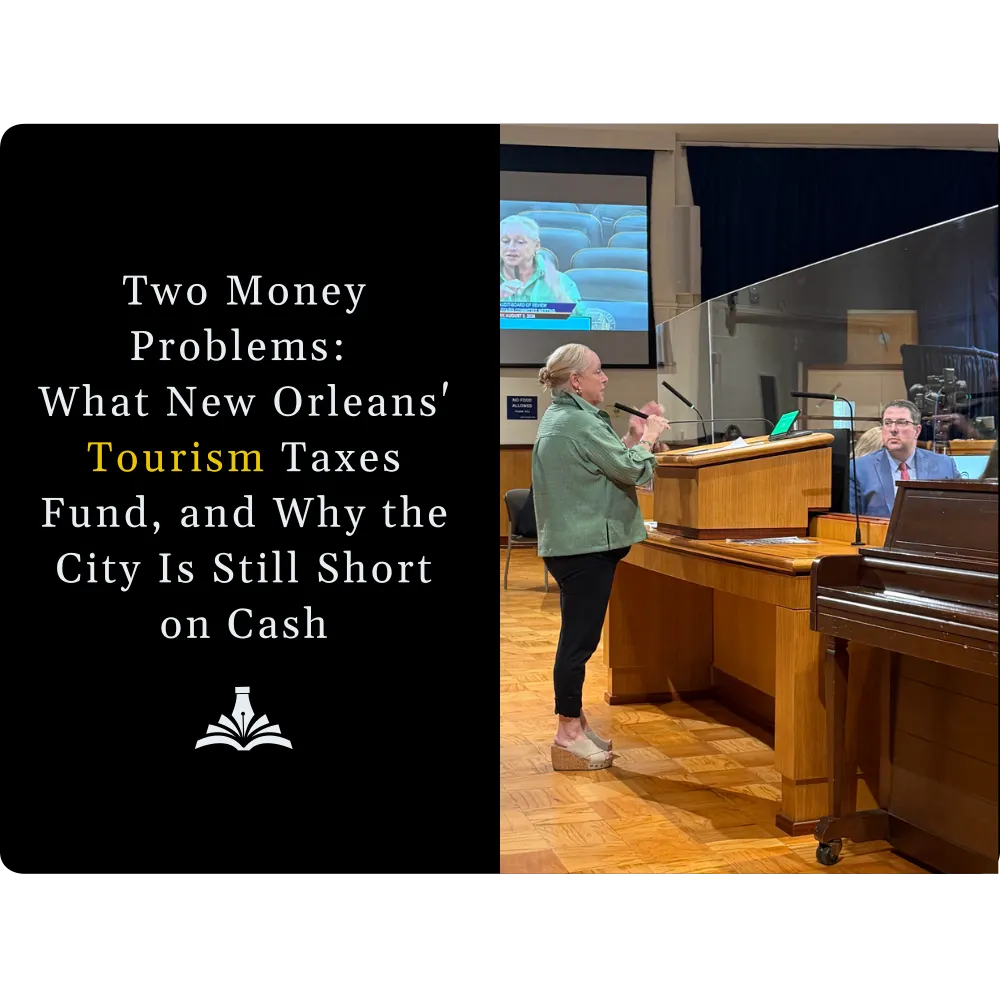
The first is structural. It is the way hotel taxes have been divided in Orleans Parish for more than half a century, and it explains why so little tourism money reaches the city's general fund. The second is immediate. It is a cash shortfall the Moreno administration laid out in detail for a City Council committee on Aug. 5, and its causes have little to do with how hotel taxes are split.
Keeping the two ledgers apart is the only way to see either one clearly.
Where the hotel tax actually goes
New Orleans hotel guests pay one of the highest lodging tax rates in the country, roughly 16.35 percent on a room charge. According to the Bureau of Governmental Research, an independent public-policy organization that has studied the structure for years, those taxes generate close to $200 million annually.
Very little reaches the city to spend as it chooses. In BGR's landmark 2019 analysis, about 75 percent of hotel tax revenue, roughly $150 million, went to entities that support tourism marketing, conventions, and professional sports. The share available for general municipal purposes was 9.5 percent, or about $18.9 million.
The largest recipients are familiar landmarks. The Louisiana Stadium and Exposition District, which oversees the Caesars Superdome and the Smoothie King Center, the Ernest N. Morial Convention Center, and New Orleans & Company, the private nonprofit that markets the city to visitors, each draw more from the hotel tax than the city's general fund does.
Less than a dime of every dollar in hotel tax has historically reached the city to spend as it sees fit.
That is the answer to the question people keep asking. The tourism money is not missing. It is committed, by law and by a structure built decades ago, to the buildings and agencies that host and sell the tourism itself.
The penny the city gave up in 1966
The imbalance traces to a single decision made when the Superdome was still an idea.
When New Orleans landed its NFL franchise in 1966, voters imposed a hotel tax to fund construction of the Superdome. To ease the new burden on a young tourism industry, the city agreed to suspend its own 1 percent sales tax on hotel rooms. BGR named this the "lost penny."
The suspension was framed as temporary. It is still in place. More than half a century later, the city can apply only 1.5 percentage points of its 2.5 percent sales tax to hotel rooms, while newer taxes dedicated to marketing and conventions have layered on top. BGR has called the arrangement an outlier among large parishes and peer cities, where the full local sales tax typically applies to hotel stays.
The penny the city set aside to help tourism grow was never reclaimed, even as tourism became one of the largest sectors of the regional economy.
What the 2019 deal moved, and what it did not
The structure is not frozen. In 2019, then-Mayor LaToya Cantrell brokered what she called the "fair share" deal, an agreement with the state to route new tourism revenue toward the city's long-neglected infrastructure.
By BGR's accounting, the deal produced about $30.8 million in recurring revenue in 2023. The majority, $21.9 million, went to the Sewerage and Water Board. The Department of Public Works received $5.7 million. New Orleans & Company kept the remaining $3.2 million for tourism promotion. The deal also delivered $57 million in one-time funding, including $28 million from the Convention Center and $24 million from the state.
BGR concluded the money is doing measurable work. Public Works has roughly doubled its annual street maintenance funding, to about $15 million. Even so, the same report noted that figure remains less than a third of the $50 million the city estimates it needs each year just to keep streets in repair.
The fair share deal moved real money toward infrastructure. It did not rewrite the underlying split, and it was never large enough to close the city's structural gaps.
The bulk of the hotel tax still flows where it flowed before. That structural question is a long game. The cash the city was scrambling to find this summer is a different matter entirely.
Budget is not cash
That distinction is not the newsroom's framing. It is the City's.
In its Aug. 5 presentation to the joint budget committee, the administration built an entire section around a single idea: a budget is not the same as money in the bank. Its own illustration was blunt. A one-dollar budget with 25 cents in the bank means not every bill can be paid.
The numbers behind that line are stark. Measured against budget, the city looked healthy. As of the June 30 reports, actual revenues had exceeded actual expenses by about $103.7 million, largely because of one-time revenues. Yet the city reported only $38.7 million in actual cash on hand as of July 31.
The gap between those two figures is the whole story. A budget can be balanced on paper while the checking account runs dry, because grants are reimbursed only after the city spends, prior-year revenue is still owed to the city, and a short-term loan taken out in 2025 had to be repaid with 2026 cash.
That last item matters. The administration also asserts that the prior administration made improper use of short-term rental tax cash, the same fair-share revenue stream at the center of the tourism debate. That is the one genuine thread connecting the two ledgers. It is the administration's characterization, offered to the committee as an inherited problem, and it awaits the city's own supporting documentation.
What it took to get this far
The city did not reach August by accident. It got there by spending down one-time money.
By the administration's account, the cash shortfall was originally projected to arrive in April. Budget and cash maneuvers stretched that to August. One-time revenues added to the 2026 budget grew from about $75 million to roughly $125 million. A Cash Management Fund the administration built to time cash infusions drew on a long list of sources, including Sewerage and Water Board reimbursements, grant reimbursements, federal pandemic-aid reclassifications, agency transfers, and Wisner Trust funds, together totaling about $131.5 million. A renegotiated Caesars agreement, the presentation said, restored the city's unassigned fund balance to a healthier level.
The city bought time by spending money it can spend only once. The administration itself calls these steps painful and not repeatable.
What still has to be closed
Even after all of that, the presentation put the remaining need at roughly $110 million through the end of the year.
The administration had planned to bond against its own funds, raising cash and repaying it over a longer horizon. That plan required approval from the State Bond Commission. In July, the city withdrew its application and began devising other ways to stay liquid. The presentation described that withdrawal in neutral terms; outside reporting has tied it to friction with state leadership.
Without state approval, the administration laid out three options: do nothing and miss payroll or vendor payments, which it called disastrous; tap only the Caesars fund with immediate repayment; or spread the need across several sources. The third path, its preferred one, breaks down as $35 million in bond-eligible expenditures, $5.5 million in additional pandemic-aid reclassification, $20 million in additional Sewerage and Water Board receivables, $25 million in additional grant reimbursements, and $25 million from the fund balance, to be immediately repaid, tapping the rainy-day fund under charter provisions in place of the Caesars money. The total comes to about $110.5 million.
The gap underneath the crisis
None of the one-time fixes touch the deeper problem, and the presentation was candid about it.
The city's recurring revenue, about $725 million a year, does not cover its recurring costs, about $850 million, before a $125 million loan repayment is even counted. That structural imbalance, not the division of hotel taxes, is what keeps the crisis returning. Looking ahead, the administration estimated a 2027 budget gap of about $125 million, rising to roughly $150 million once fund-balance repayment is included, absent new recurring revenue.
This is where the two questions finally meet, and where the answer disappoints anyone hoping tourism dollars are the fix. The hotel-tax structure is a real and long-running argument about how a large committed revenue stream is divided. The cash crisis is about a recurring gap between what the city takes in and what it spends. Redrawing the tourism split, even substantially, would not by itself close a $125 million structural hole. Understanding the city's finances means holding both truths at once, and not mistaking one for the other.
How to follow this
- Who decides: The New Orleans City Council must approve the administration's plan to move funds and close the remaining cash need.
- The document: The administration's Aug. 5 financial update was presented to the Joint Budget/Audit/Board of Review and Governmental Affairs Committee and is part of the meeting record.
- The figures that matter: $38.7 million cash on hand as of July 31; a remaining need of about $110.5 million through year end; a projected 2027 gap of $125 million to $150 million.
- Where the agenda and record live: City Council agendas and committee materials are posted at council.nola.gov, with meetings archived on the city's Granicus video portal.
- The source documents: BGR's hotel-tax and fair-share reports are at bgr.org.
Kim M. Braud is the Founder & Editor of Evans Cutchmore Press, an independent newsroom covering Louisiana and the Gulf South. Her reporting focuses on government accountability, infrastructure, business, culture, and the public policies that shape communities. Her work combines investigative journalism, public records research, and documentary storytelling.
© 2026 Evans Cutchmore Press. All rights reserved.