
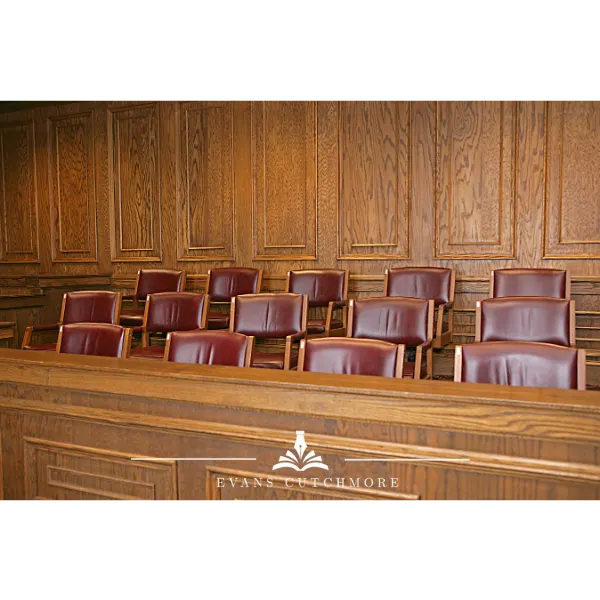
A grand jury does not decide guilt or innocence. It decides only whether prosecutors have shown enough to move a case into criminal court, and in Louisiana the rules on who may bring that case are narrower than the public debate often suggests.
By Kim M. Braud | August 1, 2026
A grand jury is a group of citizens selected by the court. Its job is not to determine guilt or innocence. It decides whether prosecutors have presented enough evidence to establish probable cause that a crime was committed and that a particular person likely committed it.
Think of it as a screening step before a criminal case reaches trial. The standard is much lower than proof beyond a reasonable doubt, which is what a trial jury applies.
In Louisiana, a grand jury is made up of 12 citizens. Any offense punishable by death or life imprisonment must be presented to a grand jury before the case can go to trial.
Who presents the case
In Louisiana, the prosecutor, usually the District Attorney's Office, presents the witnesses and the evidence.
The proceeding does not look like a trial. There is no judge deciding the facts. The defense usually does not present evidence. The person under investigation generally is not present. The proceedings are conducted in secret.
That secrecy is intended to protect witnesses, preserve the integrity of investigations, and protect people who are ultimately not indicted.
How the vote works
After hearing the evidence, the grand jury votes. In Louisiana, at least 9 of the 12 jurors must agree to return an indictment.
If enough jurors believe probable cause exists, they issue a true bill, which becomes an indictment. If they do not, they return a no true bill, and no indictment is issued.
An indictment is not a conviction. It means only that the criminal case can move forward in court.
A grand jury does not decide guilt. It decides only whether a case can move forward.
Where the district attorney fits
The District Attorney is the elected prosecutor for the judicial district. The office decides whether to investigate, what evidence to present, which witnesses to call, and what charges to seek.
Prosecutors guide the presentation. The grand jury makes the final decision on whether to indict.
What role the attorney general can play
This is where confusion often arises. The Attorney General is not automatically involved in every local criminal prosecution. Under the Louisiana Constitution, the District Attorney holds the primary authority to prosecute crimes in each judicial district, and the Attorney General has no original jurisdiction in criminal cases.
Depending on the law and the circumstances, the Attorney General may advise and assist a district attorney, but only when the district attorney makes a written request. The office may investigate or intervene in specific matters with the district attorney's consent, such as certain homicide cases.
The Attorney General may also institute, prosecute, or intervene in a criminal case for cause, but only when authorized by the court with jurisdiction and subject to judicial review. Under those same court-authorized conditions, the office may supersede the attorney representing the state.
The limit is the key point. The Attorney General cannot simply take a prosecution away from a district attorney. Absent the district attorney's request or consent, that step requires cause and the authorization of the court.
The attorney general cannot simply take a prosecution away from a district attorney.
Whether the Attorney General had a role in any specific grand jury matter depends on the legal authority under which the office participated, not on whether it publicly commented on the case.
Why the attorney general's role is being debated
When public officials disagree over who directed an investigation or influenced an indictment, it helps to separate legal authority from public perception.
A few factual questions do most of the work. Which office actually presented the evidence to the grand jury? Did the Attorney General's Office formally participate, and if so, under what authority? Who signed the indictment? Which prosecutors appeared before the grand jury?
Those questions can usually be answered through court records, official statements, or the applicable Louisiana statutes.
What readers should remember
A grand jury does not decide whether someone is guilty. It decides only whether prosecutors have presented enough evidence to justify moving a case into the criminal court system.
The determination of guilt or innocence comes later, either from a trial jury or through another lawful resolution of the case.
Kim M. Braud is the Founder & Editor of Evans Cutchmore Press, an independent newsroom covering Louisiana and the Gulf South. Her reporting focuses on government accountability, infrastructure, business, culture, and the public policies that shape communities. Her work combines investigative journalism, public records research, and documentary storytelling.
© 2026 Evans Cutchmore Press. All rights reserved.