
NEWS
The Council also sent the rest of the inclusionary zoning overhaul to the City Planning Commission, which must hold a public hearing before any further changes return for a vote.
By Kim M. Braud | October 4, 2026
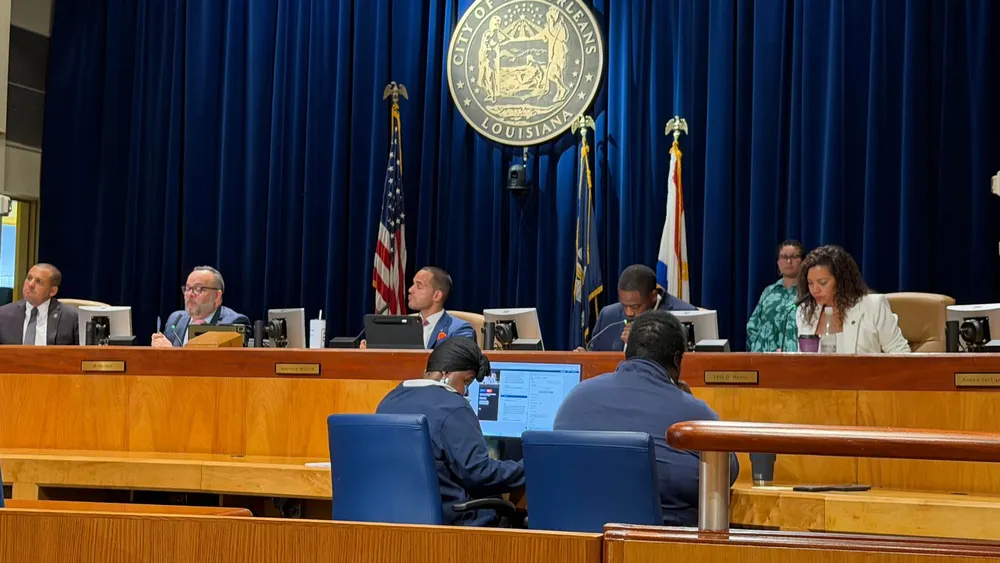
NEW ORLEANS | The New Orleans City Council voted Thursday to reduce the fee developers pay to skip building required affordable units, from $304,810 per unit to $10,000, and to deposit those fees in the New Orleans Housing Trust Fund.
The ordinance, Calendar No. 35,530, was introduced by District B Councilmember Lesli Harris. As filed, it set the fee at $5,000 per unit. Harris amended it on the floor to $10,000 before the final vote.
In a companion vote, the Council adopted Motion M-26-432, which directs the City Planning Commission to hold a public hearing on further changes to the program. Those changes include the share of units a project must set aside as affordable, the income level those units serve, and the zoning incentives offered in return.
Neither measure drew a no vote.
What the program requires
Mandatory inclusionary zoning took effect in New Orleans in 2021. In designated parts of the city, certain market-rate developments must include affordable units finished to the same standard as the market-rate ones. A developer who does not build them can instead pay a fee for each required unit not provided. That fee, set in Section 26-648 of the City Code, is the number the Council changed Thursday.
The policy rests on a 2019 study by the consulting firm HR&A Advisors, which recommended an in-lieu fee option structured to encourage on-site production. Final report, March 2019
Why the Council changed it
Harris told colleagues that HR&A updated its analysis in a report released in November 2025. She said the firm found the local real estate market had shifted sharply since the original study, with COVID, tariffs, supply chain problems and rising insurance costs driving up development costs for affordable and for-profit builders alike.
According to Harris, the report concluded that almost all development in the city is infeasible without subsidy, before any affordability requirement is added. She said hundreds of affordable units have been built in New Orleans using tax credits and other financing, but that the 2021 policy itself has produced none.
We are preserving the structure of the MIZ program so that higher fees in lieu and more robust requirements can be reinstated when the city real estate market is stronger.
Harris described the motion as the start of a process, not its end. The Planning Commission will hold a hearing and transmit recommendations, and the Council will take public input again before acting.
What residents told the Council
Two people spoke during public comment.
Jordan Rogers read a statement on behalf of Andreanecia Morris of HousingNOLA. The statement asked the Council to defer the ordinance and return it to the Planning Commission for full review. It argued that the fee cut ignores most of the November 2025 recommendations, and that developers could pay a small fee and still remain eligible for public subsidies and incentives.
The statement noted that the fee reduction was the only part of the recommended package the Council was acting on that day, while the other changes would wait for the Planning Commission process.
Public resources must produce measurable public benefit.
Ron Loisel spoke in support of the increase from $5,000 to $10,000. He suggested the Council look at whether permitting fees for transient lodging could also support the affordable housing fund when the city's transient lodging study comes before it.
Also on Thursday
Short-term rental on Toledano Street. The Council approved a modified conditional use for a newly built triplex at 1622 Toledano Street, allowing one of its three units to operate as a commercial short-term rental and requiring the other two to remain residential. The City Planning Commission had split 4 to 4 and sent no recommendation. Harris noted each unit has five bedrooms. The vote was 5 to 1, with Council President JP Morrell voting no.
Two historic district appeals. On motions by King, the Council granted modified approvals in two appeals of Historic District Landmarks Commission denials, at 1426 to 1428 Delphine Street (a porch gate and removed roof ridge tiles) and 1505 to 1507 Esplanade Avenue (windows and trim on new construction). HDLC staff asked the Council to uphold both denials, noting the work was done without permits or certificates of appropriateness. King said in both cases the contractor, not the owner, was at fault. Both passed 7 to 0.
EMS Medicaid funding. The Council moved $1.2 million within the Health Department budget for an intergovernmental transfer to the Louisiana Department of Health. Harris said the payment supports a program estimated to bring New Orleans EMS about $7.9 million a year in enhanced Medicaid reimbursements. (Calendar No. 35,548)
Crime camera and New Lab funding swap. On a King ordinance, the Council moved bond money from the Real Time Crime Center project to the New Lab project, which King said had moved faster than its federal Community Development Block Grant funding allowed. The block grant dollars will be redirected to the crime center. (Calendar No. 35,570)
Quarterly capital budget. A capital budget amendment reconciles FEMA projects, shifts bond funds from projects that came in under budget, and reallocates minor street money among council districts, including $2 million to the Sewerage and Water Board for drainage point repairs. (Calendar No. 35,556)
Returned Habitat for Humanity money. The Council appropriated the remaining $250,000 of a $1 million allocation that Habitat for Humanity returned to the city, sending it to the Department of Code Enforcement for operations and outstanding settlements. The other $750,000 had already gone to the Right to Counsel program. District D Councilmember Eugene Green said he remained disappointed that Habitat did not offer residents of the units it sold a chance to buy them. (Calendar Nos. 35,557 and 35,558)
Council security contract. The Council authorized a cooperative endeavor agreement with the Orleans Parish Sheriff's Office for City Council security in 2026, capped at $48,915.27 a month, or $586,983.24 for the year. Separately, an ordinance introduced on first reading would repeal an earlier ordinance for the same services, citing an error in the calculation of salary and fringe benefits owed to the Sheriff's Office. (M-26-426; Calendar No. 35,589)
Battery storage program. Two resolutions by District A Councilmember Aimee McCarron set parameters for Phase Three of the Energy Smart battery energy storage program and approved ICF International as third-party incentive administrator, with EnergyHub also weighing in on program guidelines. McCarron said both firms were in Entergy New Orleans' proposed implementation plan and drew no objection during the comment period. (R-26-421, R-26-437; Docket UD-24-02)
Sewerage and Water Board seat. Under a suspension of the rules, the Council confirmed Councilmember Jason Hughes' appointment to the Sewerage and Water Board, representing the chair of the Public Works, Sanitation and Environment Committee, for a term ending June 30, 2030. The vote was 7 to 0.
Other items. The Council allowed the city to buy non-plug-in hybrid vehicles under its fossil fuel vehicle rules; extended a cooperative endeavor agreement with the National WWII Museum for an Andrew Higgins Drive streetscape project, with construction estimated at $4 million and a contract award anticipated in May 2027; amended a green infrastructure agreement with Sankofa Community Development Corporation in the Lower Ninth Ward; approved a Wisner Trust settlement involving the Salvation Army; set special event clean zones for the 2027 French Quarter Festival and Satchmo SummerFest; and called April 17, 2027 elections in the Downtown Development District and a second special district.
Recognitions. The meeting opened with the Council's 13th annual Breast Cancer Awareness Day, honoring survivors from each district and medical professionals from LSU Health, University Medical Center and the New Orleans Health Department. The Council designated the intersection of Lake Forest Boulevard and Wright Road as the Taj Rudolph Honorary Intersection, for the 25-year-old District E neighborhood liaison, and adopted a resolution honoring historian and author Frank Perez, co-founder of the LGBT+ Archives Project of Louisiana, who died in August.
On first reading
Ordinances introduced Thursday include changes to the city's short-term rental regulations that the ordinance describes as required by the U.S. Court of Appeals for the Fifth Circuit (Calendar No. 35,597, Morrell), and conditional use requests for two hotels in the transient lodging interim zoning district, at 1722 to 1732 Pauger Street and 714 to 716 Carondelet Street. First-reading ordinances are not voted on at introduction.
How to follow this
- Next City Council meeting: Thursday, October 15, 2026, in the Council Chamber at City Hall, 1300 Perdido St. Several items were deferred to that date, including an HDLC appeal and a zoning docket.
- Agendas: Posted at council.nola.gov.
- How to Participate: Members of the public may comment on agenda items at New Orleans City Council and council committee meetings by submitting a comment card to the Clerk. Speakers generally have two minutes per item, and comments must relate to the matter being considered. Written comments may be emailed to clerkofcouncil@nola.gov for inclusion in the meeting record, though they are not automatically read aloud. For details, visit the Council’s rules and regulations.
- Your councilmember: Contact information for all seven members is at council.nola.gov.
Kim M. Braud is the Founder & Editor of Evans Cutchmore Press, an independent newsroom covering Louisiana and the Gulf South. Her reporting focuses on government accountability, infrastructure, business, culture, and the public policies that shape communities.
© 2026 Evans Cutchmore Press. All rights reserved.