
CULTURE, HISTORY AND PRESERVATION
Kim M. Braud | July 20, 2026
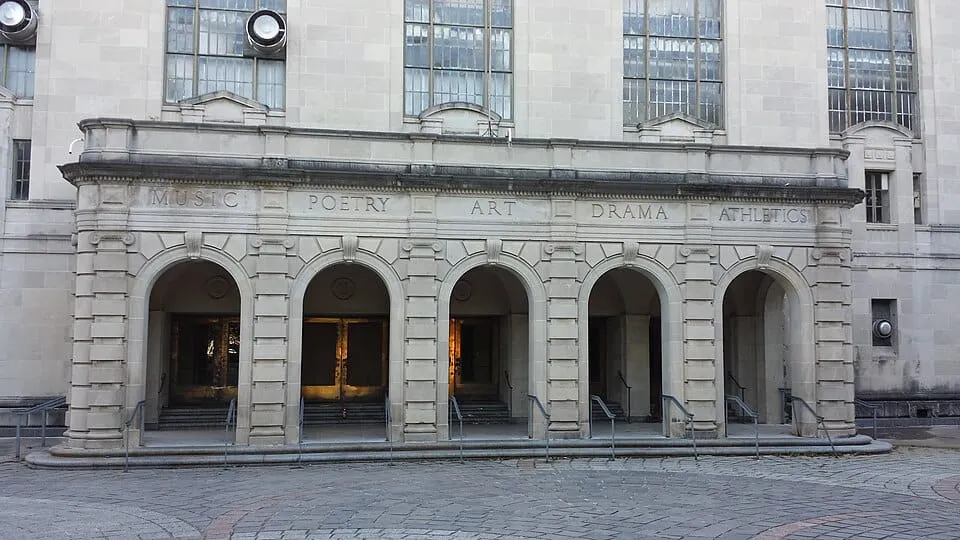
I graduated high school at Municipal Auditorium. I was presented at my debutante ball there. Two of the proudest nights of my young life, in a hall I was certain I knew.
I did not know what the ground underneath it used to hold.
I found out the way I find out most things these days, by pulling a thread and following it further than I meant to go. A simple question about the auditorium turned into a history I had walked across without ever feeling it under my feet.
Before the auditorium
That block in Tremé, the one now shared by Municipal Auditorium and Louis Armstrong Park, was once the Orleans Parish Prison.
It was built in 1834 on the square bounded by Orleans, St. Ann, Marais, and Tremé Streets. It held prisoners for roughly sixty years, until the 1890s, when the city moved its jail closer to Tulane Avenue. The old structure was demolished to make way for the auditorium, which opened in 1930. The park came later.
Photographs from that era still survive, including one of the execution yard. Because that is what the prison had. Not a metaphor. A yard where the state carried out its sentences, in the open, sometimes before crowds.
Pauline
One of the people put to death on that ground was a young enslaved woman named Pauline.
I want to tell her story plainly, with only what the record supports, because this is exactly the kind of history that New Orleans loves to embroider. Here is what holds up.
Pauline was young and enslaved. According to a contemporary account published in 1846, she was sexually exploited by her enslaver, made the victim of her master. She was convicted of striking her mistress. Under Louisiana law at the time, an enslaved person who raised a hand against a white person could be sentenced to death, and she was. When it was discovered that she was pregnant, her execution was postponed until after she gave birth, and she was returned to her cell. She was hanged in 1846.
That delay was not mercy. It followed an old common-law doctrine known as pleading the belly, under which a condemned woman found to be pregnant had her execution stayed only until she delivered. The stated purpose was to spare the unborn child, not the mother.
I will not give you more than that, because more than that is not documented. You may hear that Pauline was the first woman executed there, or read tidy endings about what became of her child. I cannot confirm those, and the earliest source does not support them. What is certain is enough. A young enslaved woman was used, condemned, kept alive to deliver a child, and then hanged, on the block where I would one day be presented at a ball.
Same ground, different century
So here is what I am sitting with.
I danced in a white gown on ground where an enslaved woman was hanged. I turned my tassel where the city once staged its executions. Nobody told me. You are not supposed to find this out. You find it out by accident, decades later, doing your own digging, and then you cannot put it back.
This is not a story about a building. It is a story about how a place holds more than one truth at a time, and how easily we let the newer truth erase the older one. We put our celebrations on top of our hardest history, pour a slab over it, hang the banners, and forget there is a second layer down there at all.
I do not think the answer is to feel guilty for having been happy on that ground. My graduation was real. My ball was real. Pauline was real too, and so was the yard. New Orleans has always asked us to hold both at once. That is the work of loving this city honestly. You do not get the celebration without the ground it stands on.
I had no idea. Now I do. And I would rather carry the full weight of a place than the pretty half of it.
Where it stands now
The auditorium is closed today. It has been shuttered since Katrina, going on twenty years of damage, neglect, and vandalism, a grand hall left to fall apart in plain sight.
But the ground is contested again, the way it always seems to be. In February 2026, Mayor Helena Moreno, the City Council, and the Save Our Soul Coalition launched a strategic master plan to redevelop the Municipal Auditorium and Louis Armstrong Park. I was in the room when the council took up the money for it. The plan is real, it is moving, and it is expected to take the better part of a year just to chart the course.
What matters most to me is what the community is fighting to protect. The same grounds hold Congo Square, the sacred place where enslaved and free Black people once gathered to drum, dance, and remember themselves as human. The coalition is pushing to make sure the redevelopment honors that history rather than paving over it. Sit with what that means. The enslaved who gathered at Congo Square, the enslaved who died at the prison, and the people deciding right now how this ground will be remembered, all on the same few acres.
The money is fragile. Roughly thirty-nine to forty million dollars in FEMA reimbursement is in limbo while the city waits on an extension it has not been granted. And in June 2026, the state funding set aside for the project was vetoed by the governor. So the plan moves forward on uncertain footing, which is its own kind of honesty about how this city tends to treat its hardest places.
I have a stake in this. I celebrated on that ground. Now I know what else it held, and whatever rises there next should carry all of it, not only the part that was easy to love.
How to follow this
If you want to see the history for yourself, a few places to start:
- The 1846 abolitionist account of Pauline's case, republished in the antislavery press of the period, which is the earliest telling and the one closest to the events.
- Henry Castellanos, New Orleans As It Was (1895), which devotes a chapter to Pauline. Read it with care. It was written half a century later by a Creole judge who defended slavery, and much of the folklore around Pauline appears to trace back to it rather than to any court record.
- The New Orleans City Archives and Special Collections, which hold Parish Prison records and can confirm dates and locations.
- The Historic New Orleans Collection, which holds photographs of the prison, including its execution yard.
If you were also graduated, married, presented, or celebrated at Municipal Auditorium, I would like to hear from you. Part of recovering this history is remembering, out loud and together, what that ground has carried.
Photo by Spatms, via Wikimedia Commons (CC BY-SA 3.0).
Kim M. Braud is the Founder & Editor of Evans Cutchmore Press, an independent newsroom covering Louisiana and the Gulf South. Her reporting focuses on government accountability, infrastructure, business, culture, and the public policies that shape communities. Her work combines investigative journalism, public records research, and documentary storytelling.
© 2026 Evans Cutchmore Press. All rights reserved.