COASTAL LOUISIANA | NEWS ANALYSIS
Decommissioned offshore capsules have become the most durable landmarks on Isle de Jean Charles, the island Louisiana is helping its last residents leave.
By Kim M. Braud | August 9, 2026
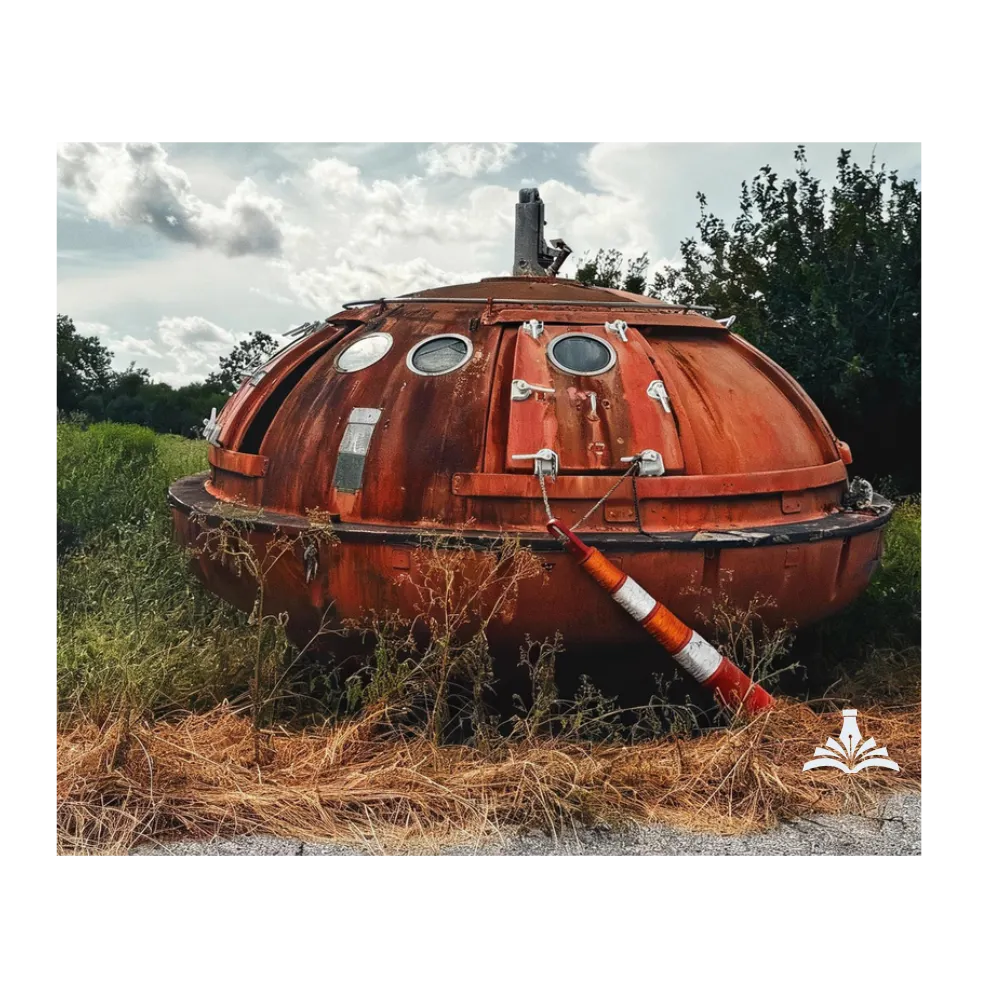
ISLE DE JEAN CHARLES, La. - Two orange capsules rest in the tall grass beside the road onto the island, portholes catching the gray light, hatches sealed, rust bleeding down their steel flanks. They look like something that fell from the sky. They are the opposite. They came from the sea.
Each is a survival capsule off an offshore oil or gas platform. The round, enclosed craft were built to drop into the Gulf in a blowout or a storm and keep a crew alive until a boat could reach them. The first models were spherical, single-hook capsules made for offshore rigs, later folded into the maritime category of totally enclosed survival craft. Coast Guard crews who pulled workers out of them in the 1980s described round orange vessels that looked like flying saucers, stocked with radios and small supplies of food and water.
On Isle de Jean Charles, that origin is the whole story. The offshore industry, which researchers link to the canal dredging and subsidence that accelerated this coast’s land loss, also built the capsules that now sit as the island’s last landmarks. One of them, parked for years across from a longtime resident’s home, has appeared in national coverage of the island’s slow disappearance. A second now rests nearby.
An island measured in what is gone
The numbers come from the state’s own resettlement program. Isle de Jean Charles once spread across more than 22,000 acres. About 320 remain. Island Road, the single two-lane link to the mainland, was built in 1953 and floods regularly under high tides and storm surge.
In 2016 Louisiana received a $48.3 million share of a larger $92 million federal disaster-resilience award to move residents who chose to leave. The state bought 515 acres of higher farmland near Schriever, about 40 miles north, and residents named it The New Isle. It has been described from the start as the first federally funded, community-scale climate resettlement in the country.
The capsules were engineered to survive the water. The island under them was not.
A shelter framing the record does not fully carry
Outside outlets have described the island pods as a last resort, a shelter or lifeboat for anyone who could not cross the flooding road before a storm. Inside Climate News framed one that way in 2021, calling it a possible final chance for those who stayed. What the public record establishes is narrower. These are decommissioned rig capsules, not a shelter program, and they have stood on the island long enough to become fixtures in the photography of its retreat.
Whether anyone has ever ridden out a hurricane inside one is not documented here. What is visible is the object itself, sealed and rusting at the edge of a road that leads to fewer homes every year.
What the capsules mark
Monuments are usually built on purpose. These were not. They are industrial cast-offs that outlasted the households around them, and that is what makes them legible. On a coast losing ground faster than almost anywhere in the country, the most permanent thing on Isle de Jean Charles is a pair of escape pods that were never meant to stay.
The people the state set out to move are moving. The land is still going. The capsules, built to float when everything else fails, remain on dry ground that is becoming less dry, marking a place by outlasting it.
Photo: Kim M. Braud, August 8, 2026. Isle de Jean Charles, La.
Kim M. Braud is the Founder & Editor of Evans Cutchmore Press, an independent newsroom covering Louisiana and the Gulf South. Her reporting focuses on government accountability, infrastructure, business, culture, and the public policies that shape communities. Her work combines investigative journalism, public records research, and documentary storytelling.
© 2026 Evans Cutchmore Press. All rights reserved.